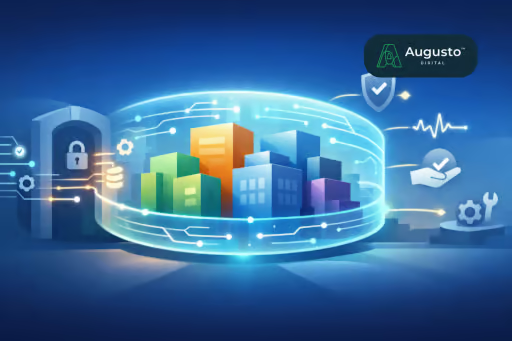
You don’t need a brand-new “AI stack.” If you already run a CRM/ERP, ticketing, warehouse, and line-of-business apps, the fastest and safest approach is to add an AI capability layer that can read approved context, make recommendations, and (sometimes) act through controlled interfaces.
If you want the quick version, watch Harnessing workflow and AI for business ROI.
Think of AI as a:
- new system of record
- workflow replacement
- layer that improves cycle time, throughput, and consistency—with governance and observability built in
A practical architecture that holds up across industries includes five layers:
- Data & retrieval: trusted context and traceability
- Model portfolio: the right model for each job
- Orchestration: workflow logic that coordinates humans and tools
- Tool APIs/adapters: safe, auditable paths to action
- Ops, monitoring, security & governance: quality, risk, and cost controls
What AI workflow integration should mean
AI integration isn’t “adding a chatbot.” It’s embedding AI into real work. Therefore, teams ship faster, handle more volume, and reduce rework. Meanwhile, they avoid hidden risk.
Most organizations should follow this maturity curve:
AI observes → AI suggests → AI acts (with guardrails).
Start to suggest (draft, triage, recommend). Earn your way into acting once quality and controls are proven.
Data Layer and Retrieval for AI (Trusted Context, Minimized Exposure)
Prioritize context from:
- Systems of record: warehouse/lakehouse, ERP/CRM, ticketing, core services
- Knowledge stores: policies, SOPs, contracts, manuals, playbooks
- Event trails: audit logs and workflow events
As a starting point, these design moves help prevent “AI chaos” later:
- Retrieval over replication: pull what you need when you need it
- Entitlements-first: mirror user/service permissions end-to-end
- Data minimization: include only fields required for the task; redact aggressively
- Traceability: store what the model saw + citations to sources
Cross-industry examples:
- Manufacturing: SOP + maintenance history → corrective action summary
- Retail: order + return policy → recommended resolution steps
- Financial services: product/policy docs → compliant response draft
- Public sector/education: case notes + guidance → summarize and route
Model Layer for AI (A Portfolio, Not One “Magic” Model)
Use a mix of:
- A general model for language + reasoning
- Smaller models/rules for classification, extraction, routing, PII/toxicity detection
Two non-negotiables:
- Model abstraction: swap providers/versions without rewriting products
- Task-fit selection: don’t pay premium reasoning costs for low-risk extraction
Orchestration Layer for AI (Turn AI Into a Workflow)
Typical chain: At first, retrieve. Subsequently, draft and validate. If required, approve. Ultimately, write back via tools.
Examples of guardrails:
- “AI may propose a refund; human approval required above $X.”
- “AI may update limited CRM fields only when confidence is above Y and changes are logged.”
Orchestration is also where adoption lives. For instance, it includes inline feedback and versioned prompts and workflows. As a result, teams can turn failures into evaluation cases.
Monitoring, Evaluation, Security, and AI Governance
If you need a lightweight governance backbone, align your controls and language to NIST’s AI Risk Management Framework and, where formal management systems matter, ISO/IEC 42001.
Track signals across:
- System health: latency, errors, tool failures
- Quality: accuracy/helpfulness, deflection, rework rate, first-contact resolution
- Risk: policy violations, PII exposure attempts, blocked tool calls, injection attempts
- Unit economics: cost per outcome (per resolved case, approved draft, qualified lead)
Build eval sets from real workflows (top ticket types, top policy questions, top exception paths). Generic benchmarks won’t predict your results.
Use patterns that integrate around your existing systems.
AI Cost, ROI, and Risk Management
If ROI doesn’t move, in that case it is usually workflow design, not the model. For example, teams may be missing context. Additionally, they may have unclear decisions, weak tooling, or poor escalation rules.
Use cost per outcome metrics (not “total tokens”):
- Cost per resolved case, per approved draft, per compliance review assist, per qualified lead
Engineer risk mitigation into the layer:
- Entitlements + minimization + redaction
- Logs of inputs, retrieved sources, tool actions, approvals
- prompt-injection defenses by isolating tools and restricting retrieval, using patterns from the OWASP Top 10 for LLM Applications and the LLM Prompt Injection Prevention Cheat Sheet, plus practical techniques described in Microsoft’s guidance on defending against indirect prompt injection.
Next Steps to Add AI Without Replacing Your Stack
- Pick one measurable workflow: define success in business terms
- Stand up the minimal AI layer: sidecar, retrieval, tools, logging, and evaluation
- Create a governance fast path: clear permissions and approval thresholds
- Instrument unit economics from day one: cost per outcome, latency, and quality
- Build adoption loops: training, feedback capture, and evaluation set growth
Let's work together.
Partner with Augusto to streamline your digital operations, improve scalability, and enhance user experience. Whether you're facing infrastructure challenges or looking to elevate your digital strategy, our team is ready to help.
Schedule a Consult