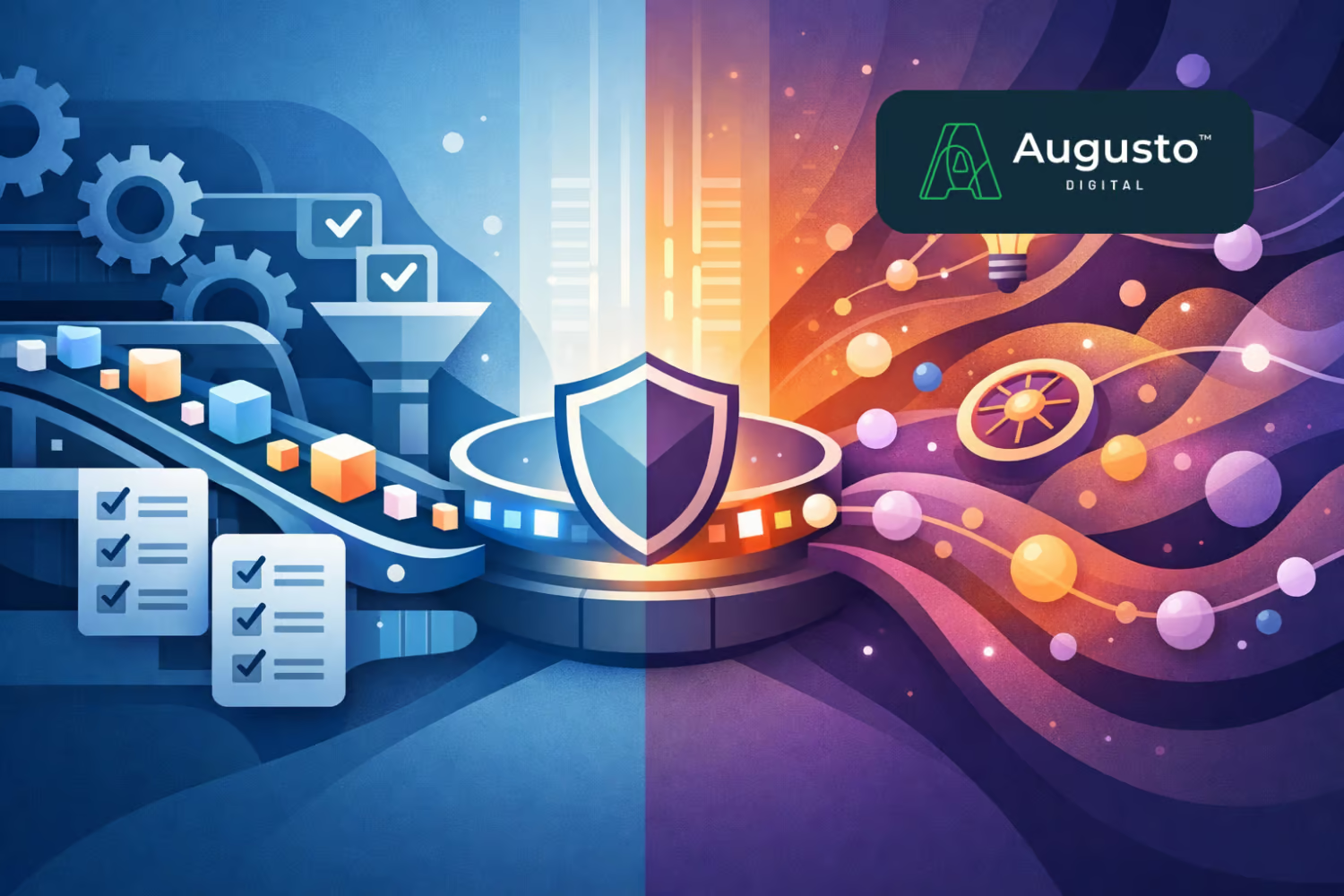
In Agent Workflow Automation, the key difference between deterministic and non-deterministic agents is the difference between executing a script and pursuing a goal. In practice, the 2026 play is hybrid: deterministic guardrails for reliability + auditability, paired with LLM reasoning for ambiguity.
Why this distinction matters right now
Most teams can demo agents. Fewer can scale them, especially when two‑thirds of companies say they’ve abandoned AI adoption projects due to AI skill gaps.
That gap usually comes from treating “agents” as one thing. They aren’t. Deterministic and non-deterministic behavior have different risks, governance needs, and ROI timelines, and AI‑critical skill shortages are now a real execution constraint.
Pick the wrong approach, and you get either (even as 62% of organizations report experimenting with AI agents).
Deterministic agents execute the script
Deterministic systems are built for repeatability: same input → same output, the kind of behavior you want when the business needs a consistent, provable path.
They excel at rule-driven workflow control:
- validations and schemas
- routing, SLAs, approvals
- permissions and logging
- writing to systems of record
When you must be able to prove what happened (and why), deterministic behavior is non-negotiable, whether you’re meeting technical safeguard requirements or keeping pace with electronic recordkeeping expectations.
Where deterministic agents tend to fit best:
Use deterministic control when being wrong is expensive or auditability matters:
- payments, refunds, credit limits
- access provisioning and role changes
- contract triggers, regulatory submissions
- approvals and system-of-record updates
- high-volume routing/triage with clear rules
Non-deterministic agents pursue the goal
Non-deterministic agents are designed to reach an outcome in messy conditions, closer to how humans work when inputs are incomplete or ambiguous. (If you need a clean shared definition, use what AI agents are.) LLMs make this practical by interpreting intent, handling ambiguity, synthesizing context, and drafting output.
Best-fit work (cross-industry):
- summarizing tickets/cases and recommending next steps
- drafting responses, comms, follow-ups
- exception interpretation (logistics, billing, claims, returns)
- intake triage (IT, HR, legal, procurement)
Key rule: let the model think, but don’t let it silently commit, especially as agentic AI is predicted to resolve a large share of routine service work over the next few years.
Why the hybrid architecture scales
Most production systems use two layers:
- Deterministic control layer (guardrails)
- scoped permissions (least privilege)
- structured inputs/outputs
- approvals and hard stops for high-impact actions
- logging + replayability
- Non-deterministic reasoning layer (LLM)
- interpret, summarize, propose options
- draft artifacts
- plan next steps
Hybrid wins because it’s useful (LLM) and trustworthy (controls) , aligned to practical GenAI risk controls and the security reality of excessive agency.
A practical playbook for decision makers
- Start with a workflow, not a chatbot: Pick a process with measurable friction.
- Design the boundary: LLM can interpret, summarize, draft, propose, and route. LLM cannot approve, pay, provision, submit, or update systems of record without deterministic validation.
- Constrain tools like a new hire: Narrow scope, and add approvals where the blast radius is big.
- Monitor, don’t hope: Track quality and safety, and build fallbacks plus escalation.
- Choose a starter that’s ROI and safe: Case summarization, intake triage, and knowledge retrieval with drafts.
How to choose AI agent development services: what to ask first
Ask questions that separate demo builders from production teams:
Security and control
- How do you prevent prompt injection and instruction hijacking?
- How do you scope tool access and enforce approvals when you’re using tool calling patterns like function/tool execution?
Reliability and quality
- How do you detect confident errors and inconsistency?
- Can you show failure modes: missing data, ambiguity, malicious inputs, partial outages?
Governance and operations
- What’s logged, and can you replay decisions end-to-end?
- What does post-launch monitoring look like?
Final thought
Hybrid isn’t a compromise. It’s the blueprint:
- Deterministic guardrails make systems trustworthy.
- Non-deterministic reasoning makes them useful.
Design the boundary well, and you get speed and safety across industries.
Let's work together.
Partner with Augusto to streamline your digital operations, improve scalability, and enhance user experience. Whether you're facing infrastructure challenges or looking to elevate your digital strategy, our team is ready to help.
Schedule a Consult