

Episode 06: Listen to this post as a podcast (23 min)
Open the episode page to share it or listen later.
A technology director at a large organization laid it out plainly on a call in August. His team was already using AI to write code. They had guardrails. They had automated testing. And they were still stuck, because the problem was not the code. It was the product owner, the backlog, and acceptance criteria that nobody could agree on. All the other sectors, he said, are moving at 200 miles an hour, and we are going at ten.
That is the honest state of AI in software development at most mid-market companies. The typing got faster. The system around the typing did not. This post is about the system.
Faster code is not faster delivery
The numbers explain the frustration. Stack Overflow’s 2025 survey of nearly 50,000 developers found that 84 percent use or plan to use AI tools, yet trust in their accuracy has fallen to 33 percent, and 45 percent say debugging AI code takes longer than expected. Only 3 percent report high trust in AI output. Meanwhile Veracode found that AI-generated code carries security flaws in 45 percent of tasks.
Put those together and you get a lifecycle where one stage sped up and every downstream stage absorbed the cost. Ambiguous requirements become confident, wrong code faster than ever, which is the productivity tax of almost-right code. Review queues lengthen. Testing finds the problems that a clear acceptance criterion would have prevented.
AI made the cheapest part of software development cheaper. The expensive parts, deciding what to build and proving it works, are still yours.
Where AI actually helps across the lifecycle
The leverage is upstream and downstream of the code, not only in it. Here is where we see it pay off.
- Backlog grooming: AI can turn a messy intake of requests, tickets and meeting notes into structured stories with a consistent shape. The product owner still decides priority, but they start from a clean draft instead of a blank page.
- Acceptance criteria: This is the biggest win we see. When a story includes explicit, testable criteria before development starts, AI-generated code has something to be checked against. Spec-driven development, where the specification is the source of truth, is how the fastest teams are working now.
- Test generation: AI writes test cases from acceptance criteria quickly. That turns a criterion into a gate instead of an aspiration.
- Review support: AI can flag obvious issues before a human reviewer spends time, which is how you keep the human review workflow from becoming the bottleneck.
- Documentation and handoff: The least loved work in engineering is the easiest to delegate, and it is what protects you when a developer leaves.
The part that does not change
Ownership does not change. Someone has to be the master of what the system needs to do. A CEO we spoke with this summer was rebuilding a core platform piece by piece and asked the right question: is my team doing it right? His architects were senior. His developers were productive. What he wanted was a check on the process, from spec to acceptance, because he understood that the tools would only amplify whatever process was in place.
Judgment does not change either. Deciding when AI can make a call and when a person must is a framework, not an instinct. Our post on when AI should make the call applies to engineering decisions as much as business ones.
What this looks like in practice
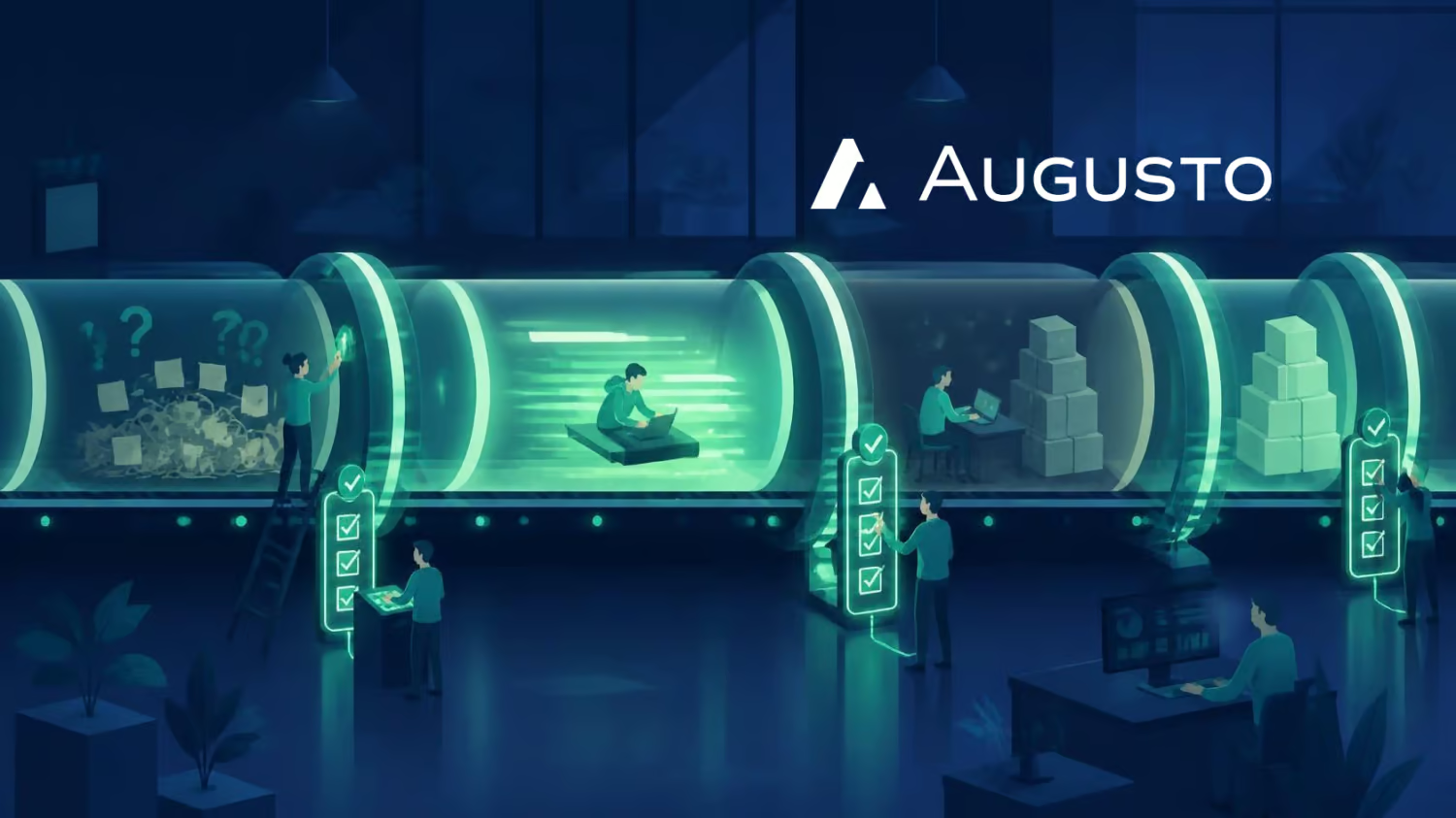
The pattern across our engineering work is consistent. We start with a short diagnosis of how work flows from request to release, because nine times out of ten the slow step is not where the team thinks it is. Then we redesign the stages where AI carries the weight: intake, story drafting, acceptance criteria, test generation, documentation. Developers keep their judgment and their code review. AI carries the repetitive load.
For one team, adoption was the barrier, not capability. Some engineers did not want to use AI tools to build code, for reasons that ranged from pride to fair concern about quality. The fix was not a mandate. It was a demo built from their own backlog, showing what changed for them, followed by a process that made the safe path the easy path. We wrote about that dynamic in how to get your team to actually use AI, and the same lessons hold for engineers.
McKinsey’s research on AI in software development points the same direction: the largest gains come when teams redesign the workflow around the tools, not when they bolt tools onto the old workflow. The state of AI research is clear that workflow redesign is what separates value from experimentation.
Fix the lifecycle, then add the speed
The gap between AI aspiration and AI that works in engineering is the gap between faster typing and faster delivery. Aspiration measures lines of code. AI that works measures how long it takes a clear requirement to become a tested feature in production, and it redesigns every stage in between. That is Engineering Intelligence, and it is the diagnosis we run before we touch a toolchain.
Your developers already have the assistants. Give them the specs, the criteria and the gates, and put AI to work for your people across the whole lifecycle.
Frequently Asked Questions
Where does AI help most in software development?
Upstream and downstream of the code: turning requests into structured stories, drafting testable acceptance criteria, generating tests, supporting review, and writing documentation.
Why is our team not faster even though we use AI coding tools?
Because AI sped up one stage. Ambiguous requirements, slow review and weak testing absorb the gain. Fix the lifecycle first.
What is spec-driven development?
A practice where a clear, testable specification is written before code and treated as the source of truth, so AI-generated code has something to be checked against.
Do we still need code review with AI?
Yes. Independent testing finds security flaws in nearly half of AI-generated code. Review and testing are what make the speed safe.
Let's work together.
Partner with Augusto to streamline your digital operations, improve scalability, and enhance user experience. Whether you're facing infrastructure challenges or looking to elevate your digital strategy, our team is ready to help.
Schedule a Consult