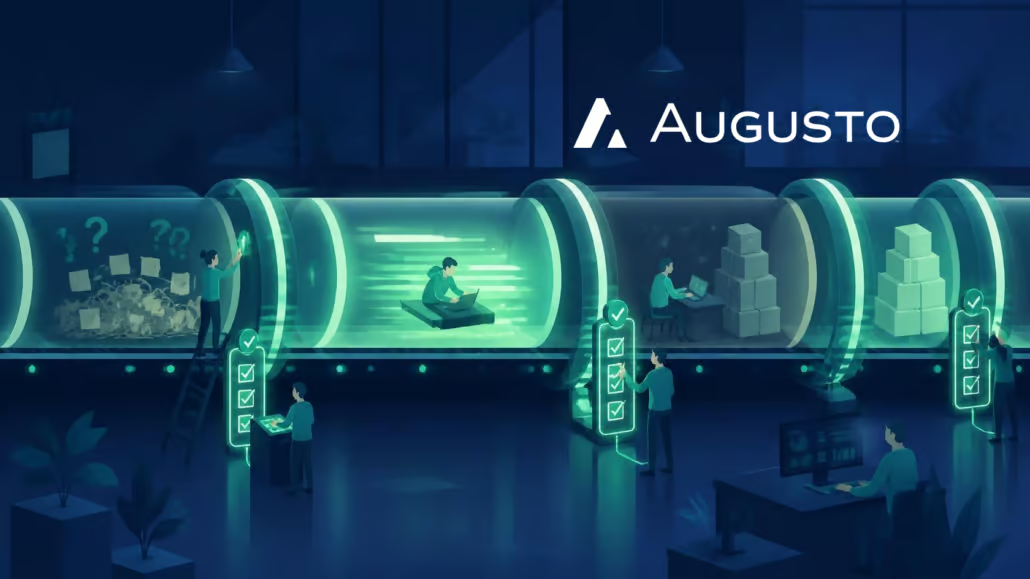
Think about the work your team repeats every single day. Someone rekeys data from a PDF into another system, someone else chases a status update by email, and a third person stitches together numbers from three tools to build the same report they built last week. None of it requires much judgment, yet all of it eats hours your people could spend on work that actually moves the business. That everyday friction is exactly what AI workflow automation is built to remove.
The opportunity is enormous. McKinsey estimates that current AI and related technologies could automate activities absorbing 60 to 70% of employees’ time, much of it the repetitive data collection and processing that fills a normal workday. The goal is not to replace your team. It is to hand the tedious parts to software so your people can do the parts only people can do.
What an AI workflow actually is
An AI workflow is a chain of steps that runs across your existing tools, using AI to read information, make a decision, and take an action, with a human stepping in where judgment matters. It is not a chatbot you ask questions. It is a quiet process that does the work, moving a document, updating a record, drafting a response, or flagging an exception, without someone shepherding every step.
This is where the market is heading fast. Deloitte’s guidance on agentic AI strategy points to workflows where AI agents carry out multi-step tasks on their own, coordinating across systems rather than waiting on a person to click through each screen. The best of these feel invisible, because the work simply happens.
Examples of AI workflows we build
The clearest way to understand the value is to look at the kinds of workflows we put into production for mid-market teams. Every example below is drawn from real client work, generalized to protect confidentiality.
- Document and order processing
Quotes, purchase orders, and invoices arrive as messy PDFs in wildly different formats, and someone usually retypes them by hand. We build workflows that read those documents, pull the right fields even when layouts differ, and route each one to the correct place, whether that is the ERP, accounts payable, or the shipping team. One such workflow processes well over a hundred quote documents a day without errors, and in another case the equivalent of a full-time role was freed from manual certificate processing.
- Finance close and reporting
Instead of waiting until weeks after month-end to see the numbers, we connect the underlying systems and let a workflow reconcile and recognize revenue and costs on a near-daily basis. A close that once stretched across many days collapses toward one or two, and leaders finally see performance while they can still act on it.
- Sales intelligence
Reps sit on insight that never reaches leadership. We build workflows that turn call transcripts and CRM history into a weekly sales report surfacing win and loss patterns, and that rank target accounts by opportunity so the team starts where the odds are best. These are practical AI quick wins that pay back within 90 days when scoped well.
- Knowledge and support
When every question routes to the same overloaded expert, work stalls. A private knowledge assistant lets staff self-serve accurate answers drawn from your own documentation, deflecting repetitive questions and, in one case, saving a support team roughly a hundred minutes a day.
Making workflows seamless for your people
Automating a task is easy. Making it stick with the people who do the work is the hard part, and it is where most efforts quietly fail. McKinsey has found that nearly 80% of organizations simply layer AI on top of existing processes without rethinking how work flows, so the tool never actually changes the outcome. Seamless workflows come from redesigning the process around the tool, not bolting the tool onto the old steps.
The human side matters just as much. Prosci reports that roughly 70% of AI adoption challenges trace back to people and process rather than technology, which is why we design workflows to augment your team and bring them along. We keep a human in the loop wherever judgment counts, make the automated path the easiest path, and give people back their time for higher-value work. When the “right way” is also the simplest way, adoption follows.
Why workflow projects stall, and how we prevent it
Plenty of automation efforts launch with a demo and then fade. The workflow drifts, no one owns it, and the team drifts back to the manual habit. Governance is a big reason, since Deloitte’s State of AI in the Enterprise research shows most organizations still lack a mature model for running AI in production. We treat a workflow as a system we run and improve, backed by ongoing support and maintenance, so it keeps working as your business changes rather than decaying after launch.
Let’s make your workflows seamless
Every team has repetitive work hiding in plain sight, and most of it can be handed to a well-designed AI workflow. Through our AI activation work, Augusto identifies where automation will pay off first, builds it into your existing tools, and keeps it running in production, not just on a slide. If your people are spending their days on work a workflow could handle, book a call with our team and we will help you find the first one worth building.

Frequently Asked Questions
What is AI workflow automation?
It is the use of AI to run multi-step processes across your existing tools, reading information, making decisions, and taking actions with a human involved where judgment matters. It removes repetitive manual work rather than replacing the people who do it.
How is an AI workflow different from a chatbot?
A chatbot answers questions when asked. An AI workflow does the work on its own, moving documents, updating systems, and flagging exceptions as part of a process that runs in the background.
What kinds of tasks are a good fit?
Repetitive, rules-based work with clear inputs and outputs is ideal, such as processing documents, reconciling data, routing requests, and generating routine reports. These tasks are common, costly, and well suited to automation.
Will AI workflows replace our staff?
The aim is to augment, not replace. By taking the tedious steps off your team’s plate, workflows free people for the judgment, relationships, and problem-solving that software cannot do.
How do we get started?
Start by finding one high-friction, repetitive process, prove the value quickly, and design the workflow around how the work actually flows. From there you can expand with confidence and clear ownership.
Let's work together.
Partner with Augusto to streamline your digital operations, improve scalability, and enhance user experience. Whether you're facing infrastructure challenges or looking to elevate your digital strategy, our team is ready to help.
Schedule a Consult