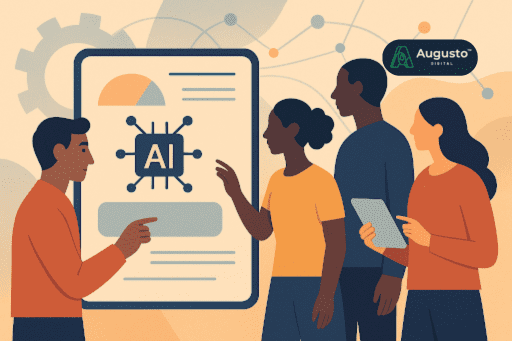

AI is reshaping how organizations operate, serve their communities, and unlock new opportunities for growth, supported by leading nonprofit AI research. how organizations operate, serve their communities, and unlock new opportunities for growth. In addition, as adoption accelerates, leaders must balance innovation with responsibility. Ethical, inclusive AI isn’t just about risk mitigation; instead, it’s about building trust, strengthening your brand, and ensuring AI investments deliver real outcomes.
Whether you’re in healthcare, manufacturing, financial services, nonprofits, or scaling a SaaS product, the principles remain the same: Above all, AI should amplify human capability, protect stakeholders, and advance your mission, not compromise it.
At Augusto, we believe responsible AI and accelerated AI go hand in hand. In fact, when designed with intention, ethical AI becomes a multiplier for value, trust, and long-term growth.
Watch a demo on building an App with AI Tools.
Safeguard Data to Strengthen Trust
Organizations today steward sensitive data, patient information, financial records, customer insights, employee data, donor histories, and more. AI amplifies both the opportunity and the responsibility tied to this data.
Protecting privacy isn’t a compliance checkbox. Rather, it’s foundational to earning trust, data privacy is a top AI risk, and enabling sustainable AI adoption.
Best Practices for Secure, Trustworthy AI
- Obtain clear consent and follow all relevant regulations. Ensure your AI systems comply with HIPAA, GDPR, SOC2 guidelines, and any industry-specific standards.
- Vet AI tools, cloud infrastructure, and vendors rigorously. Not all AI platforms offer enterprise-grade privacy or security. Choose partners who prioritize encryption, access control, and ethical data use.
- Set clear rules for sensitive data. Establish guardrails for what staff can and cannot input into AI systems to avoid unintentional exposure.
- Train your teams. Many vulnerabilities come from misuse, not malice. Empower teams with practical guidance and ongoing support.
- Create governance and oversight. Treat AI data use as a governance discipline with leadership visibility, clear accountability, and regular audits.
Outcome: Stronger stakeholder confidence and a safer, scalable foundation for AI-driven innovation.
Reduce Bias and Build Fair, High‑Confidence AI
AI systems learn from the data they’re given bias remains one of the most cited ethical risks in AI, and real-world data often contains real-world inequities. Without safeguards, AI can unintentionally reinforce disparities, harm user trust, or produce unreliable outputs.
To ensure AI delivers consistent, equitable outcomes, organizations must prioritize fairness from day one.
Steps to Ensure Fair, High‑Quality AI Systems
- Use diverse, representative training data. Include all meaningful user segments across demographic, geographic, and contextual differences.
- Audit data routinely then remove outdated, inaccurate, or underrepresented inputs before they affect your models.
- Test for bias continuously. Compare outputs across groups and investigate any disparities.
- Maintain human oversight. Humans, not algorithms, make final decisions on high‑impact processes.
- Document decision criteria. Transparency builds trust and simplifies regulatory compliance.
- Continuously retrain and improve. Models drift. Data evolves. Keep your systems aligned with today’s environments, not yesterday’s.
As a result, the outcome is AI that is more accurate, defensible, and aligned with your organization’s values.
Design Inclusive AI That Works for Everyone
In every industry, digital equity matters. Whether your users are patients, employees, donors, customers, or business partners, AI experiences must be accessible, intuitive, and inclusive.
When done well, inclusive AI expands reach, increases adoption the digital divide remains a major barrier to equitable tech access, and strengthens user satisfaction.
Principles for Designing Inclusive AI
- Accessibility by design. Support users with diverse abilities through readable content, alt text, transcripts, and simplified interfaces.
- Adapt to varied connectivity and devices. Not all users have high‑bandwidth access or modern equipment; lightweight and offline-friendly options matter.
- Provide human alternatives. AI should enhance, not replace, human support. Always offer a human path for complex needs.
- Co‑create with your users. Involve diverse stakeholders early to validate tone, cultural context, usability, and trust factors.
- Localize language and cultural relevance. Ensure AI systems reflect the communities you serve.
Outcome: Broader engagement and AI tools that serve real people, not idealized personas.
Align AI With Mission, Strategy, and Business Outcomes
AI should advance your most important priorities responsible AI strengthens stakeholder trust , improving customer experience, increasing operational efficiency, reducing friction, supporting employees, and delivering measurable ROI.
Ultimately, organizations succeed when they connect responsible AI to clear business value.
How to Keep AI Mission‑Aligned
- Use a values-first decision framework. Every use case should align with your mission, ethics, and commitments to the people you serve.
- Develop a clear AI policy. Establish principles for fairness, transparency, privacy, security, and accountability.
- Engage leaders and boards early. Responsible AI is a strategic discipline, not just a technical one.
- Communicate with transparency. Make your AI practices visible and accessible to stakeholders.
- Own mistakes. Continuous learning is essential. When gaps appear, address them openly.
Outcome: AI initiatives that build credibility, accelerate adoption, and deliver consistent organizational value.
A Practical Roadmap for Responsible, High‑Impact AI
You don’t need massive budgets or large teams to implement ethical, inclusive AI effectively. Instead, you need clarity, alignment, and a practical way to start.
Here’s a proven framework for moving fast, responsibly:
- Start with Education and Principles: Clarify your shared understanding of AI organizational AI readiness is strongly correlated with training and governance, what it is, how it works, what it can and can’t do, and what “responsible AI” means for your organization.
- Identify High‑ROI, Mission‑Driven Use Cases: Start small. Choose projects tied directly to your strategic goals, workflow automation, content acceleration, triage support, analytics, compliance, or customer service.
- Build Governance and Cross‑Functional Alignment: Create an AI operations structure with stakeholders from leadership, IT, operations, legal/compliance, and frontline teams.
- Design With Transparency and Inclusivity: Communicate clearly with internal and external audiences about how AI is used and how it benefits them.
- Train, Test, Validate, and Iterate: Pilot in controlled environments. Collect feedback. Test for fairness, accuracy, and usability. Improve quickly.
- Monitor and Mature Your AI Over Time: AI systems evolve, your governance and guardrails should evolve with them.
Outcome: A responsible, scalable AI capability that delivers value early and often.
Conclusion
Ethical, inclusive AI is not a barrier to innovation. Rather, it is the foundation for long-term, high-ROI success. Organizations that lead with responsibility build trust, speed adoption, and unlock the full potential of AI.
By pairing responsible AI with rapid, outcome-focused execution, you can:
- Strengthen customer and stakeholder trust
- Improve operational efficiency
- Scale innovation safely and sustainably
- Deliver measurable ROI
- Create digital experiences that reflect your mission and values
AI is here. The organizations that adopt it thoughtfully will lead their industries.
At Augusto, we’re here to help you do that responsibly, quickly, and with confidence.
Let's work together.
Partner with Augusto to streamline your digital operations, improve scalability, and enhance user experience. Whether you're facing infrastructure challenges or looking to elevate your digital strategy, our team is ready to help.
Schedule a Consult