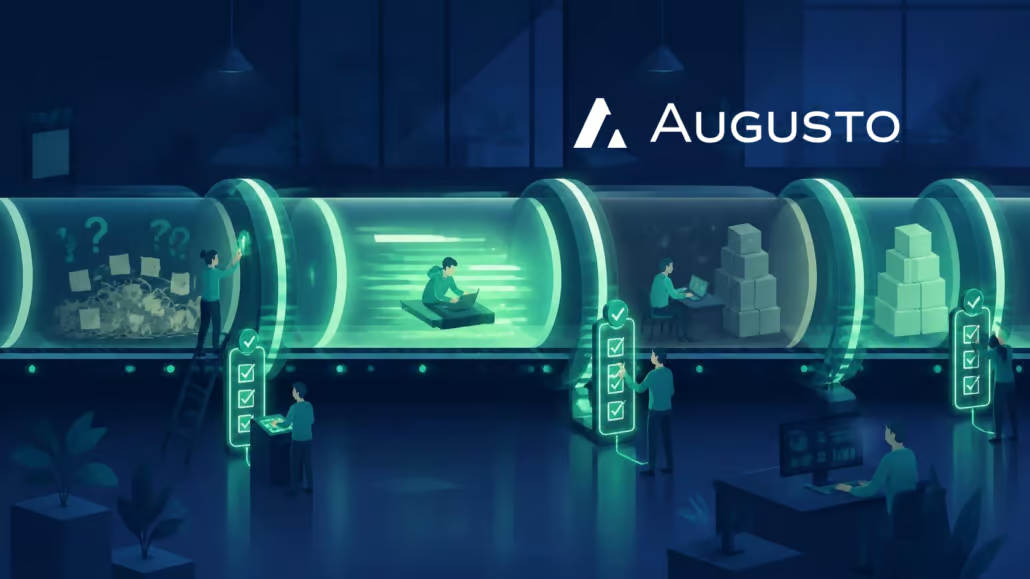
AI proof of concept work is everywhere. Almost every growth-stage company has run one. Yet research from McKinsey on AI value capture shows that only a small share of pilots actually become production systems that move the business. The pilot impresses leadership, the team celebrates, then the work quietly stalls. Funding dries up. Timelines slip. Next quarter starts with a different shiny pilot, and the cycle repeats.
The companies that escape the cycle do something different. They treat the AI proof of concept not as a demo but as the first three weeks of a production system. Here is the six-week cadence that turns pilots into workflows your team actually relies on.
Why Most PoCs Die
Five patterns show up over and over in stalled AI proof of concept work.
- Synthetic data: The pilot is built and tested on data that does not look like production. When real data arrives, accuracy collapses.
- No integration plan: The pilot runs in a sandbox. Connecting it to the CRM, ticketing system, or data warehouse becomes a separate project that nobody scoped.
- Vague success criteria: “Promising results” is not a metric. Without an agreed-upon number in advance, leadership cannot make a clean go-or-no-go call.
- Scope creep: Every stakeholder adds one more feature, and the pilot turns into a six-month build before it has proved a single thing.
- No production owner: Once the pilot ends, no one is responsible for keeping it alive. The work falls between teams and quietly dies.
Each of these is fixable. The trick is to design the proof of concept knowing exactly how you will hand it to production from day one.
What a Production-Worthy PoC Looks Like
A production-worthy AI proof of concept has five non-negotiable traits. It is scoped to one workflow with a clear boundary. It runs on real production data, not samples or synthetic sets. It integrates with at least one real system, even in a limited way. It defines success in concrete numbers like tickets deflected, hours saved, or cycle time cut. And it has a named owner who is accountable for what happens after the pilot ends, not just during it.
These traits are not new, but they are increasingly enforced by serious operators. Gartner’s enterprise AI guidance has shifted in the past 18 months from “experiment broadly” to “experiment with production discipline,” and the data on AI value capture supports the change.
The Six-Week Cadence
A focused AI proof of concept fits cleanly into six weeks when the team commits to a strict cadence.
- Week 1: Define one workflow, the success metric, real data sources, and one integration target. Hold a kickoff with the production owner already named, not chosen later.
- Weeks 2 and 3: Build the working agent or model on real data. Test against the evaluation set. Identify integration risks and resolve at least one before week three ends.
- Week 4: Run the pilot alongside humans on a small audience in production. Capture metrics daily, not weekly. Watch for the failure modes that did not show up in testing.
- Week 5: Measure against the success criteria. Brief leadership with the actual numbers, not slide adjectives. Make the go-or-no-go call based on the data.
- Week 6: Either harden for full rollout or kill the project cleanly with a documented learning report. Both outcomes are wins. A vague “we will see” is the only failure.
Augusto’s AI Accelerator runs this exact six-week cadence with growth-oriented companies. The framework, integration patterns, and measurement plan are in place from the first day, which is what makes the timeline realistic rather than aspirational.
Funding the Next Phase Before the First Ends
The smartest teams secure funding for the production phase by week four, not week seven. They share early metrics with leadership weekly, pre-write the rollout brief, and align finance on what a successful pilot means before it lands. By week six, the production decision becomes a clean yes-or-no, not a fundraising exercise that drains another month of momentum.
AI proof of concept work fails not because the technology is unready. It fails because the path from pilot to production is treated as an afterthought. Build that path in from week one, and the cycle finally breaks.
Frequently Asked Questions
1. What is the difference between a proof of concept and a pilot?
A proof of concept tests whether something is technically feasible on a small slice of work. A pilot tests whether it actually delivers value in production conditions with real users. The six-week cadence above is technically a tight pilot, since it runs on real data with real audiences. The names matter less than the discipline behind the work.
2. How do we pick the right workflow for our first PoC?
Pick a workflow with high volume, clear success criteria, clean data, and a stakeholder who actively wants the change. Avoid workflows that are politically complex, depend on data your team does not trust, or do not have a clear path to production once the pilot succeeds. Boring is good. Boring workflows produce measurable wins.
3. What if our PoC fails – is the time wasted?
No, if you ran it properly. A well-scoped PoC produces real learning even when the answer is no. You learn what your data actually looks like in production, where integrations break, and which assumptions did not hold. That learning compounds into the next attempt. The only true failure is a PoC that ends with no clear answer.
4. Should we build the PoC ourselves or use a partner?
Build internally if you have a senior engineer with AI experience, time to dedicate, and willingness to own production. Use a partner when speed matters, when the integrations are complex, or when you need someone who has shipped this kind of work before. Many teams do a hybrid: a partner sets up the framework, the internal team owns it from week four onward.
5. How do we secure budget for the production phase?
Brief finance and leadership early in the pilot, share weekly metrics, and define what a successful production rollout would cost before the pilot ends. The single biggest reason the production budget gets denied is that the request arrives after the pilot ends, when momentum has already cooled. Move the conversation up by two weeks and approval rates climb noticeably.
Let's work together.
Partner with Augusto to streamline your digital operations, improve scalability, and enhance user experience. Whether you're facing infrastructure challenges or looking to elevate your digital strategy, our team is ready to help.
Schedule a Consult