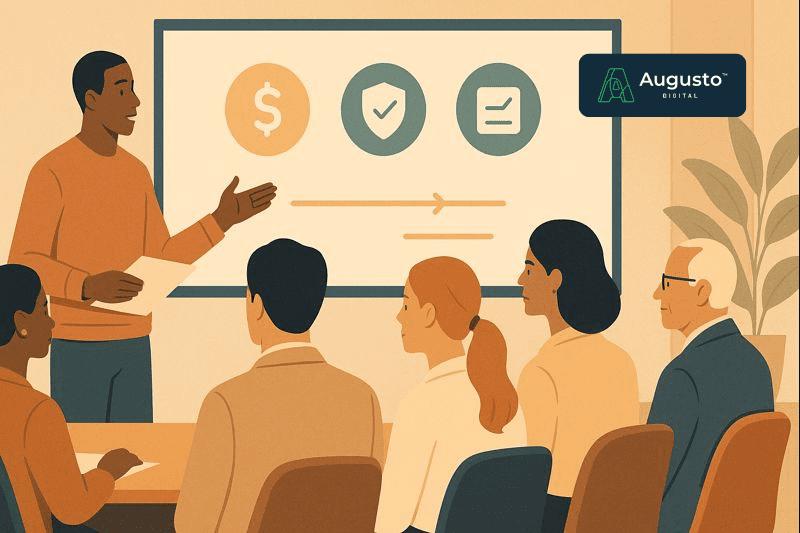
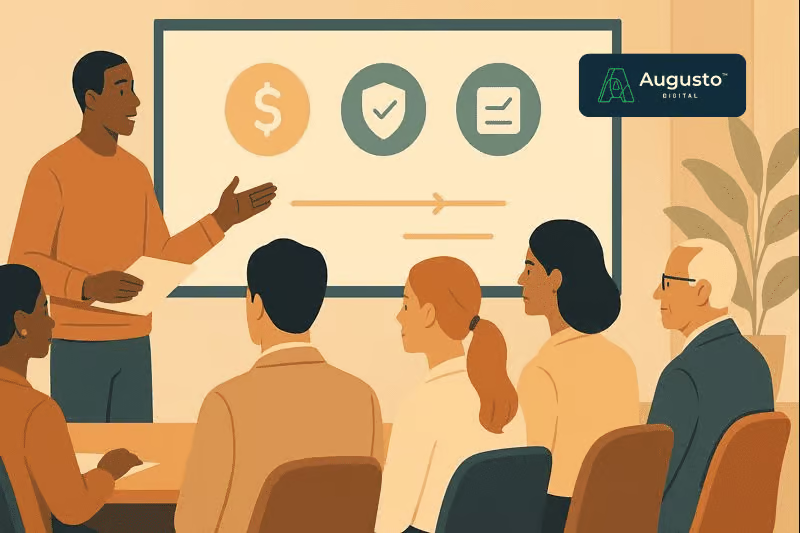
Boards do not fund “AI.” They fund a business bet with clear results, clear risks, and a clear plan. If your pitch sounds like a tech experiment, it dies in the room. If it sounds like a controlled way to improve a real business problem, it gets a decision.
This guide is written for leaders across industries, including retail, banking, insurance, telecoms, manufacturing, logistics, and the public sector. You can use it to shape your story, your deck, and your answers in the meeting.
Start with the decision the board needs to make
A strong board pitch starts with one sentence that is easy to approve.
“Approve a governed 90-day pilot. We will return with results, risks, and a scale plan. If the evidence is not there, we will stop.”
That line works because it does three things at once. It limits scope, it promises proof, and it shows discipline.
What board members need to hear before they say yes
Use this structure to keep your pitch simple and board friendly.
- The business threat and opportunity: Explain what changes if you do nothing. Keep it concrete. Are competitors responding faster? Are backlogs growing? Are costs rising? Is customer experience slipping? Tie the pressure to a part of your business the board already tracks.
- A small, credible first win: Choose one use case you can prove in 60 to 90 days with real users, real data, and clear checks. Your first win should improve speed or accuracy without changing ownership. A safe pattern is “draft, then verify” where a person still approves the final result.
- Risk and controls: Boards will ask how you prevent mistakes and protect sensitive data. Anchor your plan to NIST AI RMF and, for generative tools, use the companion NIST GenAI Profile. If your risk committee wants the full details, reference the official AI RMF PDF.
- Ownership and oversight: Name the people and the rules. Who owns the business outcome? Who owns the data? Who signs off on security and legal? Who monitors quality each week? Who can pause the tool if something looks wrong? If you want board friendly prompts, use Deloitte’s AI Board Governance Roadmap.
Pick a first use case that works in any industry
A good pilot is not the most exciting thing you can do. It is the most provable thing you can do.
Look for work that is already repetitive, already tracked, and already has a review step.
In customer-facing teams, a common first win is helping agents draft better replies faster. The person still owns the response, but the first draft is faster. You measure time saved, quality, and customer outcomes.
In risk and review teams, a common first win is triage support. The tool helps sort cases, summarize key facts, and suggest next steps. High-risk cases still require human approval, and the tool must show where it got its answers.
In operations, a common first win is assisting with exceptions. Think late orders, stock issues, equipment downtime notes, field reports, and maintenance planning. The goal is to shorten diagnosis time and make handoffs cleaner.
In knowledge work, a common first win is drafting and checking internal documents. Policies, proposals, training content, and SOP updates are often slow because people start from scratch. A draft assistant speeds up the first pass, while a reviewer ensures accuracy.
If you are unsure what to choose, start with one workflow where you can answer all of these questions without guessing: what is the input, what is the output, who approves it, how will you measure quality, and what happens if it is wrong.
Explain value without overpromising
Boards do not trust magic math. They trust simple inputs and clear assumptions.
You can acknowledge the big picture with one credible stat, then move quickly into your own numbers. For example, McKinsey estimates generative AI could drive $2.6T to $4.4T in annual value. Use that as context, then say, “Here is what it means for us, in one workflow, with a measured pilot.”
Make risk feel managed, not scary
You do not need a long risk section. You need a clear one.
Start with the idea that you are not replacing judgment. You are improving a workflow. Then show how you will control input, output, and decision rights.
Here is a simple way to explain controls in plain language:
- Data rules: Approved sources only. Restricted data blocked by default. Clear labels on what can and cannot be used.
- Output rules: The tool drafts and summarizes. People approve. For high impact decisions, the tool can support the work, but it cannot be the final decision maker.
- Quality checks: You will measure accuracy, not just speed. You will track error types and tighten checks when issues repeat.
- Security and access: Vendor review, least privilege access, and logging so you can answer “who used what, when, and why.”
- Compliance watch: Track rules that apply to your sector and your markets. If your organization operates in the EU, keep an eye on deadlines using the EU Parliament AI Act implementation timeline.
The close that earns trust
End the same way you started, with discipline.
“Approve a governed 90-day pilot. We will return with results, risks, and a scale plan. If the evidence is not there, we will stop.”
If you want help turning this into a board-ready pack, Augusto can support use case selection, value modeling, controls, and a pilot that is safe to scale.
For more content like this, visit our blog page.
Let's work together.
Partner with Augusto to streamline your digital operations, improve scalability, and enhance user experience. Whether you're facing infrastructure challenges or looking to elevate your digital strategy, our team is ready to help.
Schedule a Consult