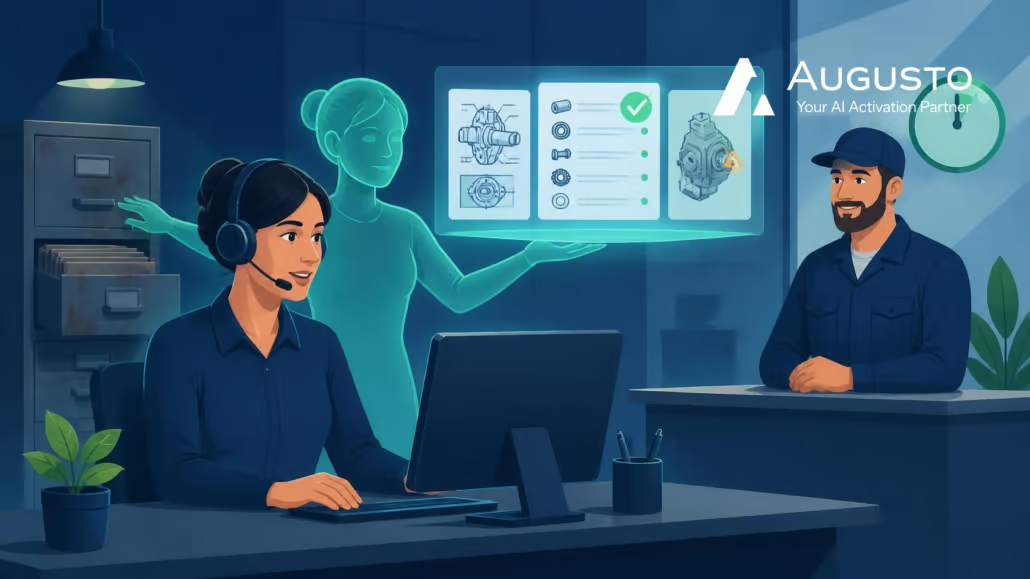
Episode 07: Listen to this post as a podcast (23 min)
Press play to listen here, or watch it on YouTube. Open the episode page to share it or listen later.
Ask a CEO what comes up first when they start an AI initiative, and it is rarely a technical question. It is this: I have people who are afraid. Employees who believe AI is coming for their job. Leaders who cannot afford to lose those people, and cannot afford to skip AI either. One executive put it to us this way: I do not have an option on using AI to transform, but it will be detrimental to lose people who think they are next.
That fear is rational, it is widespread, and it is the single biggest reason AI efforts stall after the pilot. This post is about the conversation that fixes it.
The fear is real and mostly unaddressed
Pew Research found that 52 percent of U.S. workers are worried about the future impact of AI on their jobs, and 32 percent expect fewer opportunities for themselves. Only 6 percent expect more. Meanwhile Gallup reports that just 22 percent of employees say their organization has communicated a clear plan for AI. Half of the workforce is anxious and most companies have said nothing, a pattern one analysis called adopting without direction.
Silence is not neutral. When leaders do not explain what AI is for, employees fill in the blank with the worst headline they read that week. The same Gallup data shows the upside: when leadership communicates a clear plan, employees are three times as likely to feel prepared and 2.6 times as likely to feel comfortable using AI.
Your people are not resisting AI. They are resisting a story you have not told them yet.
What to say, and what to mean
The conversation only works if it is true. Here is the version we help leaders build, in the order that lands.
- Name what AI is for: Be specific about the work it will carry. Not “efficiency.” Say: the three hours a day our engineers spend rebuilding quotes from scratch, or the invoice uploads to customer portals that nobody wants to do. People can accept a change they can picture.
- Say what it is not for: If you are not planning headcount cuts, say so plainly and mean it. If natural attrition will change the shape of the team over time, say that too. The MIT NANDA report found that companies are seeing no evidence of mass layoffs tied to generative AI; the real shift is quieter and slower. Honesty about that beats a promise you cannot keep.
- Show what changes for them: The team that gets AI-assisted quoting does not lose its experts. It gets to spend its time on the complex work that requires their judgment. A customer service leader we work with said it best after her team’s backlog fell from hundreds of open requests to around one hundred: it gives us the time to be the experts we are supposed to be.
- Give them a role in the build: Fear drops when people shape the tool. Involve the people who do the work in choosing what AI should carry, and adoption stops being a change management problem.
- Invest in them visibly: Training is the proof that you meant it. Our post on the hidden cost of not training your team makes the business case; the human case is that a trained employee stops looking over their shoulder.
The message underneath the message
There is a position behind this conversation that leaders have to choose. Some vendors sell AI as a way to remove bodies. We go the other way, and so do the companies we see winning: use AI to amplify the people who already carry the deep context of your business but are bogged down in repeatable tasks.
That is not a soft stance. It is where the returns are. A worker who knows your customers, your suppliers, and your exceptions is the asset. AI that frees that person from re-keying spreadsheets turns their judgment loose on the work that grows the company. The World Economic Forum’s Future of Jobs report projects both displacement and creation, and which side of that ledger your company lands on is a leadership decision.
What this looks like in practice
When a CEO tells us their people are afraid, the first thing we do is not a technology assessment. It is a session with the people doing the work, where they show us how things run today and tell us where the friction is. Then we build a demo from their own process. Teams that walk in defensive walk out asking what else is possible, because they have seen AI carry a task they hate and leave the part they are proud of alone.
That is why adoption is designed into the process rather than bolted on at the end. The people who will use the system help choose where it goes first, see it work early, and own the feedback loop. Our guide to escaping AI pilot purgatory covers the change management side in detail.
Say it before the rumor does
The gap between AI aspiration and AI that works is often a trust gap. Aspiration announces a tool. AI that works explains what the tool is for, what it is not for, and what changes for the person reading the email. That is HR Intelligence and Company Intelligence in the same breath, and it is the conversation we help leaders have before any system gets built.
Your people are waiting for the story. Tell it, keep it true, and put AI to work for your people rather than around them.

Frequently Asked Questions
How do I reassure employees about AI without lying to them?
Be specific about what work AI will carry, honest about how the team may change over time, and clear about what stays human. Specific beats reassuring.
Should we announce AI plans before we have a system?
Yes. Gallup found employees with a clearly communicated plan are three times as likely to feel prepared. Silence gets filled by headlines.
What if we do expect headcount to change?
Say that attrition, not layoffs, is the plan if that is true, and describe how roles will shift toward higher-value work.
How do we turn fear into adoption?
Involve the people who do the work in choosing where AI goes first, show them a demo built from their own process, and train them visibly.
Let's work together.
Partner with Augusto to streamline your digital operations, improve scalability, and enhance user experience. Whether you're facing infrastructure challenges or looking to elevate your digital strategy, our team is ready to help.
Schedule a Consult