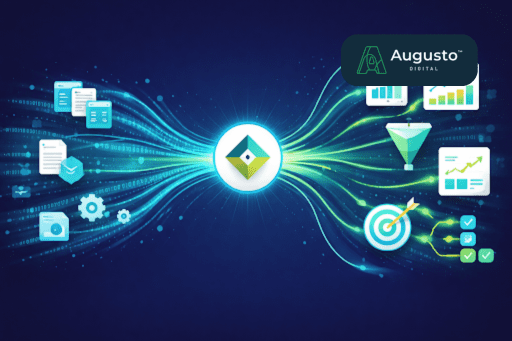

Most growing businesses do not have a data shortage. They have a clarity shortage.
Your CRM holds years of customer history. Your accounting software tracks every transaction. Marketing platforms generate reports every week. The data exists. The problem is that too much of it sits in systems that require either a technical expert to extract or enough spare time to make sense of it properly. Neither of those is a resource most leadership teams have in abundance.
This is exactly the gap AI is closing right now, and it does not require a data science team, an expensive analytics platform, or months of implementation to start getting value.
The Problem Most Businesses Recognize But Rarely Name
A SoftServe study of 750 business leaders found that 65% believe no one at their organization fully understands all the data they collect or how to access it. A further 58% reported that key business decisions are being made on inaccurate or inconsistent data most of the time. Separately, Oracle’s research across 14,000 business leaders found that 72% admitted the sheer volume of data, combined with a lack of trust in it, had stopped them from making a decision at all.
The picture that emerges is not of businesses that lack data. It is for businesses where the data is trapped, unclear, or simply too time-consuming to translate into a decision. That is the problem AI addresses directly.
What AI Actually Changes
Traditional business intelligence required someone who could write SQL queries, configure a dashboard, or wait for the analytics team to produce a report. The insight was accurate but the path to it was slow, dependent on specialists, and shaped by whoever happened to know which questions to ask.
AI changes the interface. Rather than requiring technical skills to extract insight from data, natural language querying allows non-technical users to explore their data independently, asking questions in plain language and receiving contextually accurate answers in seconds. A sales director can ask “which customer segment had the largest repeat purchases last quarter” and get an answer without raising a ticket, booking a meeting, or waiting three days.
That shift from specialist bottleneck to self-service insight is where AI produces some of its most immediate and widely felt value in a business.
The Tools Worth Knowing About
The right starting point depends on how your data is currently structured and how much complexity you want to introduce from day one.
For most businesses, the fastest entry point is a general-purpose large language model with data capabilities. ChatGPT’s Advanced Data Analysis lets you upload a spreadsheet, ask questions in plain English, and get charts, summaries, and trend analysis back within seconds. The same approach works in Claude for more structured, detailed analysis. Neither requires any technical setup. If your data lives in a CSV or Excel file, you can start immediately.
For teams that want to connect directly to live data sources, Julius AI acts as a conversational analyst, allowing users to ask questions of connected datasets and receive visual outputs without writing a line of code. ThoughtSpot takes a similar approach at a more enterprise level, letting anyone in the business type a question and get an instant, searchable answer from the company’s actual data rather than a static report snapshot.
For businesses already using Microsoft products, Power BI now includes AI features that surface anomalies, generate natural-language summaries of dashboards, and proactively flag trends without requiring users to look for them. If your team already lives in the Microsoft ecosystem, this is one of the lowest-friction upgrades available.
Where to Start: Three Practical First Steps
The most common mistake with business data and AI is trying to connect everything at once before proving the approach on something small. A tighter starting point produces faster results and builds the confidence to expand.
- Pick one business question you wish you could answer more quickly. Common examples include “which of our customers are most at risk of churning”, “which products had the highest margin last quarter”, or “where are we losing deals in the sales pipeline”. Start with a question that matters, not a data audit.
- Pull the relevant data into a spreadsheet or CSV. Clean it enough to be useful, meaning no duplicate rows, consistent date formats, and column headers that are clearly labeled. You do not need perfect data to get started. You need data that is clean enough to be trustworthy.
- Upload it to ChatGPT Advanced Data Analysis or Julius AI and ask the question in plain English. Then follow up. Ask what is driving the pattern. Ask what changed compared to the previous period. Treat the AI like a junior analyst who is fast and patient and will answer as many follow-on questions as you need.
That cycle, from a business question to an AI-generated answer with supporting visualization, can happen in under ten minutes on your first attempt. From there, the goal is to build the habit before expanding the infrastructure.
As we covered in our guide to what AI agents can do for your business right now, the next step beyond manual analysis is automating recurring reports entirely, with agents that pull data on a schedule and surface the most important changes without anyone initiating the process. That is a natural progression from the manual starting point described here.
The Bigger Picture
Businesses that use data consistently in their decision-making are three times more likely to report significant improvements in decision quality than those that rely primarily on intuition. The gap between those businesses and the ones still waiting for the right analyst or the right platform is widening every quarter.
AI does not require your business to solve its data infrastructure before getting value. It meets your data where it is, translates it into language your team understands, and surfaces the questions worth asking next. That is a meaningful shift from where things stood even twelve months ago.
If you want to identify the right data use cases for your business and build the workflows to make them repeatable, the Augusto team works with leaders to move from data chaos to clear decisions.
Schedule Meeting with an Augusto consultant.
Frequently Asked Questions
1. Do I need clean, structured data before using AI for analysis?
You need data that is accurate and consistently formatted, but you do not need it to be perfect. Start by cleaning one dataset well enough to trust the output, then build better data habits over time. Trying to clean everything before starting is one of the most common ways businesses delay getting value.
2. Can AI analyze data from multiple systems at once?
Yes, though this requires more setup. Enterprise tools like ThoughtSpot and Power BI connect to multiple live data sources simultaneously. For a faster starting point, exporting a combined dataset from your key systems into a single spreadsheet and analyzing it with ChatGPT or Julius AI produces useful results without complex integration.
3. Is it safe to upload business data to AI tools?
It depends on the tool and the data involved. Most enterprise-grade platforms include data privacy controls and do not use your inputs to train their models. For sensitive data, including financial records or customer personally identifiable information, check the platform’s data handling policy before uploading, and consider whether anonymizing the data before analysis is appropriate.
4. How is AI-powered analytics different from a regular dashboard?
Dashboards show you what happened. AI-powered analytics helps you understand why it happened and what to ask next. The conversational interface means you can follow a line of inquiry rather than waiting for someone to build a new report every time a question changes.
5. How long does it take to see value from AI data analysis?
For straightforward use cases like sales trend analysis or customer segmentation, value is typically visible within the first session. Broader adoption across a business, where multiple teams are routinely making decisions with AI-assisted data, usually develops over two to three months with consistent use.
Let's work together.
Partner with Augusto to streamline your digital operations, improve scalability, and enhance user experience. Whether you're facing infrastructure challenges or looking to elevate your digital strategy, our team is ready to help.
Schedule a Consult