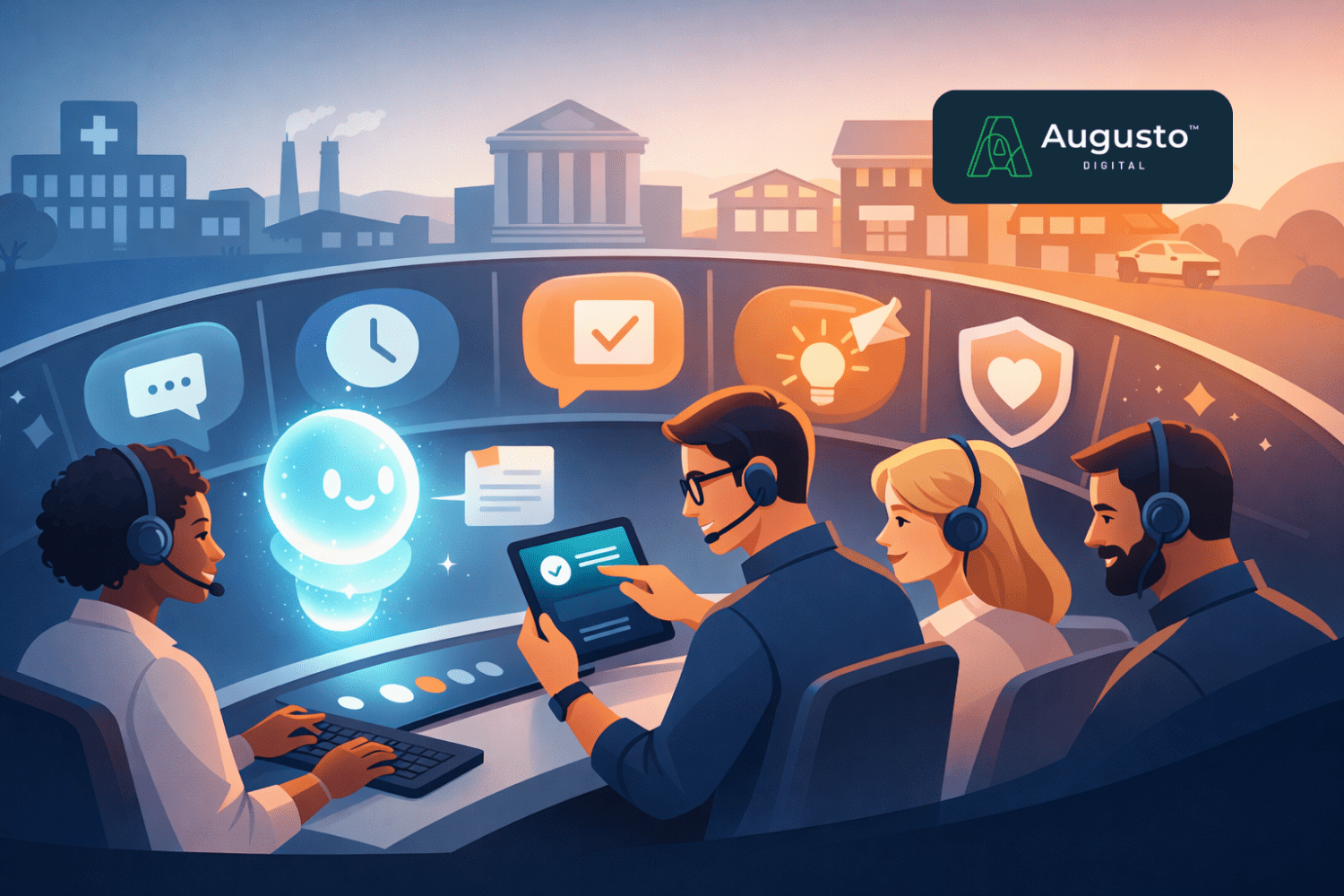
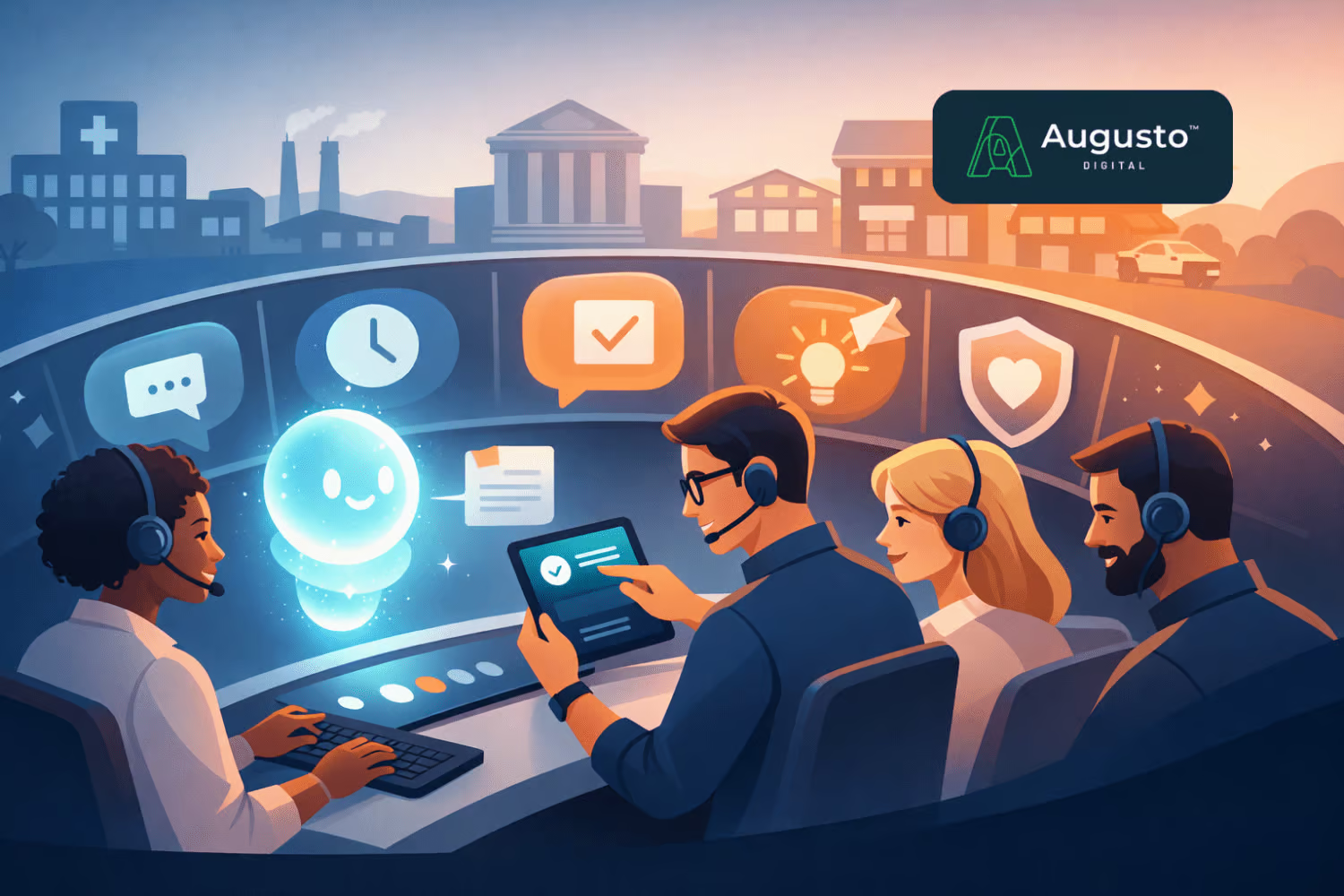
AI can improve customer experience (CX) when it reduces wait time, customer effort, and uncertainty with clear governance and a strong human escalation path.
Michigan organizations are feeling the squeeze: faster digital expectations, tighter budgets, and hiring that’s harder than it used to be. Customers are not lowering their standards. They still want quick answers, frictionless journeys, and a brand that “remembers” them. That could mean booking a doctor’s appointment, checking an insurance claim, tracking a shipment, or trying to return a jacket.
AI can help, but only when we treat it like an operating model shift rather than a shiny feature. Many leaders agree, and 65% of customer experience leaders see AI as a strategic necessity to avoid falling behind.
Across industries (healthcare and beyond), the most successful CX programs use AI to do three things well:
- Reduce waiting (speed and availability)
- Reduce effort (fewer steps and handoffs)
- Reduce uncertainty (clear status and proactive outreach)
The goal is not to replace people. It is to give customers a faster path to outcomes and give teams the tools, context, and capacity to show up as humans when it matters.
1. Deploy AI-Powered Chatbots for 24/7 Support
Chatbots earn their keep when they solve the right problems: high-volume, low-ambiguity questions customers need answered now.
One real-world example: Augusto’s work with Boston Children’s Hospital started with an overwhelmed call center handling about 1,800 patient calls a day and delivered 2x chatbot engagement in two months by moving routine questions to an always-on digital front door.
A well-designed bot can:
- Answer FAQs instantly (hours, pricing, policies)
- Guide users through common tasks (password reset, order status, appointment confirmation)
- Collect structured info before escalation (so agents don’t start from scratch)
2. Automate Routine Processes to Speed Up Service
Not every CX improvement is conversational. Often, the biggest wins come from automating the behind-the-scenes work that slows teams down.
Think: form routing, status updates, case creation, refunds, appointment reminders, identity checks, or shipping notifications.
In practice, this is where AI, RPA, and intelligent agents shine, especially when you need to connect legacy systems and modern channels. Many teams are moving beyond rules-only automation toward AI + RPA and intelligent agents that can handle more nuanced workflows. We’ve also seen service teams reduce manual follow-ups by automating reminders and handoffs by around 30% so people can focus on higher-value work.
3. Personalize Customer Interactions with AI
The key is balance. Personalization should feel helpful, not creepy.
Ethical AI personalization principles
- Start with consent and transparency. Tell people what you’re using and why.
- Give customers control over personalization settings, including an easy way to opt out.
- Use the minimum data needed. More data isn’t always better.
- Design for helpful, not invasive. If it would feel weird in person, it will feel weird in AI.
KPI metrics for AI personalization
- Repeat contact rate (Does context reduce repeat calls?)
- Conversion and completion rates in key journeys
- Customer effort score (CES)
- Opt-out rates (often a strong “creepiness” signal)
4. Leverage AI Insights to Anticipate Needs and Issues
Reactive service is expensive. Proactive service is a competitive advantage.
AI can help surface patterns humans won’t spot quickly: rising complaint themes, product defects, churn signals, or a workflow that’s silently failing.
5. Empower Your Customer Service Team with AI Assistance
Agent experience is customer experience.
AI copilots can help teams respond faster and more consistently, particularly when knowledge is spread across systems and tribal memory. They also reduce time lost when agents have to answer the same question repeatedly. AI-assisted knowledge retrieval can help reduce repeated inquiries and speed up resolution.
Examples of AI assistance for agents
- Suggested replies (editable tone and policy-aligned)
- Summaries of long threads before handoff
- Knowledge retrieval (“show me the refund policy for international orders”)
- Next-best-action prompts
6. Monitor Service Quality and Sentiment with AI
Most teams sample 1–5% of interactions for QA. AI lets you evaluate far more interactions and focus human review where it matters most. In one program, a human reviewer saved over 1,800 hours per year while catching more errors. AI can also help teams prioritize urgent and frustrated requests so attention goes to the right place.
What to monitor with AI quality assurance
- Sentiment shifts mid-conversation
- Policy compliance steps
- Resolution quality (did we answer the question?)
- Risk signals (escalation likelihood, cancellation intent, safety issues)
KPI metrics for AI quality monitoring
- QA coverage rate
- Reduction in escalations
- Improved CSAT and reduced complaint rates
7. Blend AI with Human Touch (Keep People in the Loop)
The best CX systems don’t choose between AI and humans. They choreograph them. The most reliable patterns use human-in-the-loop checkpoints so AI accelerates work without becoming the final authority on high-stakes decisions.
When humans should take over immediately
- High emotion (anger, fear, distress)
- High stakes (money, safety, compliance, health)
- High ambiguity (the customer doesn’t know what they need)
- High value relationships (key accounts, VIP customers)
Human-in-the-loop design principles that build trust
- Make AI visible without being obnoxious.
- Give customers control. “Talk to a person” should be easy.
- Explain decisions, especially for denials, limits, eligibility, and pricing.
- Test for equity across channels, geographies, and segments.
A simple AI + human operating model
- AI handles triage, basics, summaries, routing, and proactive updates.
- Humans handle exceptions, empathy, judgment calls, and relationship moments.
- Leaders handle governance, measurement, and continuous improvement.
How to Start Without Overbuilding
If you want results quickly, pick one journey that matters and ship in increments. Many teams move faster by starting with one high-impact use case instead of trying to redesign the entire service model at once.
AI is most powerful in customer experience when it reduces friction and uncertainty while protecting trust. Teams across healthcare, manufacturing, financial services, retail, the public sector, and beyond can use AI to improve responsiveness and satisfaction without costly overhauls or losing the human moments customers remember.
If you’re exploring what to automate, what to augment, and what should stay human, Augusto can help you prioritize use cases, design responsibly, and measure the impact from day one.
For more content like this, visit our blog page.
Let's work together.
Partner with Augusto to streamline your digital operations, improve scalability, and enhance user experience. Whether you're facing infrastructure challenges or looking to elevate your digital strategy, our team is ready to help.
Schedule a Consult