AI Governance is moving fast, and every organization is trying to harness it. But the moment you connect an AI system to your internal data, the game changes. The risks grow, but so do the opportunities. Your institutional knowledge is incredibly valuable, and when AI can use it responsibly, it unlocks better decisions, faster operations, and more confident teams.
This blog post breaks down what leaders across industries need to know about connecting enterprise data to LLMs. Whether you work in healthcare, manufacturing, financial services, nonprofits, or SaaS, this guide will help you approach AI adoption safely and strategically.
Why Your Data Matters
AI on its own can only get you so far. The real power emerges when your organization connects AI to:
- Policies and procedures
- Donor or customer Q&A histories
- Financial or operational workflows
- Product documentation or engineering manuals
- Patient, client, or member support insights
This is where AI becomes truly useful. But it also means your systems now interact with sensitive, regulated, and business-critical information. That’s why governance, security, and privacy matter.
How AI Uses Your Data: RAG, MCP, and Fine-Tuning
Not every AI integration works the same way. The approach you choose determines how flexible, accurate, and secure your system will be.
The Second Brain (RAG) Approach
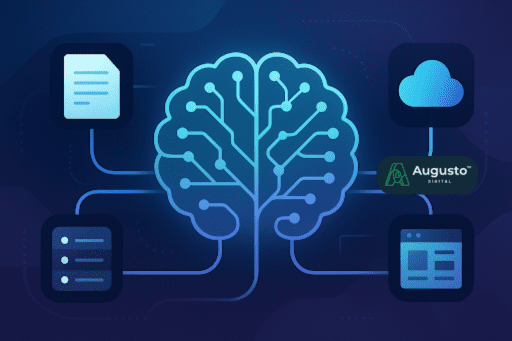
The Second Brain approach, powered by Retrieval‑Augmented Generation (RAG), gives your organization a centralized, intelligent memory that your teams can access instantly. Instead of relying on scattered documents, tribal knowledge, or outdated files, your Second Brain gathers the right information at the right time without storing it inside the model.
It retrieves relevant pieces from your content the moment someone asks a question. This creates a reliable, always‑current resource that amplifies your team’s knowledge and reduces the friction of hunting for answers.
RAG works best for:
- Policies and procedures
- User guides and manuals
- Training materials
- Donor or customer FAQs
- Knowledge bases across any industry
Why teams like it:
- It keeps answers accurate
- It reduces hallucinations
- You can update content instantly without retraining
Model Context Protocol (MCP)
MCP connects AI to live systems such as ERPs, EMRs, CRMs, or inventory systems. This gives AI the ability to bring in real‑time information.
MCP is ideal for:
- Checking current inventory levels in manufacturing environments
- Live donor or gift information in philanthropy
- Financial account lookups or status checks
- Up‑to‑date patient or client workflow data
This is the step from “AI that chats” to AI that supports actual work.
Fine‑Tuning
Fine‑tuning trains a model to follow your organization’s tone, structure, patterns, or use cases.
It is best for:
- Brand voice alignment
- Domain‑specific workflows
- Classification tasks
This method does not give a model new or updated facts. It simply shapes how it behaves.
Governance: Setting the Rules for AI
Strong governance ensures AI uses your data accurately, safely, and consistently across the organization. Good governance starts with clean information and clear ownership.
Keep Your Data Accurate and Organized
AI depends on clean, high‑quality content. Out‑of‑date documents will lead to out‑of‑date answers.
Leaders should:
- Assign clear ownership for content accuracy
- Archive outdated pages or files
- Define how new information is reviewed and published
- Apply metadata and organization consistently
Match AI Access to Human Access
AI should never have access to more information than the person using it.
For example:
- A healthcare call center agent should see patient instructions, not HR data
- A nonprofit volunteer should see public materials, not donor histories
- A manufacturing technician should see machine logs, not executive financials
Aligning AI permissions with role‑based access helps prevent oversharing.
Understand Compliance Requirements
Depending on your sector, you may be responsible for:
- HIPAA
- SOC2
- PCI
- GDPR
- CCPA/CPRA
- FERPA
Your AI systems must follow the same rules your organization already does.
Track How AI Uses Your Data
Auditability matters. Leaders should know:
- What data was retrieved
- When it was retrieved
- Who requested it
- What the model generated using that data
This transparency builds trust and helps with troubleshooting.
Security: Keeping Your Internal Knowledge Protected
Security for AI is an extension of your existing cybersecurity strategy. As AI systems access more of your internal knowledge, the controls around that access must strengthen as well. AI introduces new security risks that need careful planning.
Watch for New Threat Types
AI systems create opportunities for:
- Prompt manipulation
- Unauthorized data exposure
- Accidental data pasting into the wrong tools
- Model hallucinations that reveal sensitive information
Security teams must update threat models for AI, using resources like the OWASP Top 10 for LLM Applications.
Remove Sensitive Data Before Ingesting It
Before adding documents to your AI knowledge sources:
- Mask personal identifiers
- Remove financial account details
- Replace names with internal IDs if possible
This improves safety without reducing usefulness.
Limit What AI Retrieves Based on Who Is Asking
Permissions and data filters should always reflect the user’s real role.
This reduces the risk of:
- Internal data leaks
- Accidental oversharing
- Misuse of highly sensitive content
Keep Connections Secure
Ensure that:
- Data is encrypted in transit
- Storage systems use encryption at rest
- API keys and credentials are locked down
Monitor AI Use in Real Time
Good monitoring workflows can catch:
- Unusual access patterns
- Potentially harmful outputs
- Attempts to retrieve sensitive data
Modern cloud tools offer guardrails that add extra protection.
Privacy: Maintaining Trust With Customers, Donors, and Teams
Your privacy strategy must respect all individuals involved with your organization.
Use Enterprise AI, Not Consumer Tools
Public AI tools often store or train on your inputs. This is unsafe for:
- Patient data
- Donor information
- Financial details
- Employee records
Enterprise platforms offer data isolation and stronger protections, as outlined in OpenAI’s enterprise privacy commitments.
Anonymize Data Whenever Possible
Before uploading any information:
- Replace names with IDs
- Remove personal contact information
- Strip out financial identifiers
Choose Vendors With Clear Policies
Trustworthy vendors should offer:
- SOC2 compliance
- Data residency guarantees
- No‑retention policies
- Clear documentation on how information is handled
Treat Your Intellectual Property Carefully
Your internal knowledge is valuable. Leaders should:
- Avoid uploading proprietary formulas or source code unless absolutely required
- Monitor outputs to ensure the model isn’t returning sensitive excerpts
Choosing a Cloud Provider for AI on Your Data
Each major cloud provider approaches AI and data integration differently. Understanding their strengths helps you choose the right fit for your organization’s technology stack and risk posture. Most organizations adopt AI through a major cloud provider or a trusted enterprise platform.
Microsoft Azure
Best for teams already using Microsoft products. Azure provides:
- Strong compliance support
- SharePoint and Teams integrations
- Data residency controls
Amazon Web Services (AWS)
Ideal for organizations with complex workflows or multiple systems. AWS offers:
- Automatic redaction options
- Retrieval tools that adjust results based on user permissions
- Mature security features
Google Cloud Platform (GCP)
Best for search‑heavy use cases. GCP provides:
- Strong document retrieval capabilities
- Privacy‑first design
- Built‑in integrations that require little configuration
Direct APIs (OpenAI, Anthropic)
Best when you need full control or have strong internal engineering resources. Often preferred by SaaS companies.
Should You Self Host Your Own AI Model?
Self‑hosting gives maximum control but also requires:
- High infrastructure costs
- Deep GPU expertise
- Large security investment
Most mid‑sized organizations find that managed cloud AI is more cost‑effective and easier to support.
Key Takeaways for Leaders
To get value from AI on your data, keep these principles in mind:
- Start with enterprise-grade tools: Avoid public AI systems that could expose sensitive information.
- Clean and govern your data first: Accurate, well-organized content leads to accurate AI.
- Build security and monitoring into your foundation: Treat AI like any other system connected to sensitive data.
- Protect people’s privacy proactively: This builds trust and reduces risk.
- Choose tools that match your organization’s needs: Start with what integrates well and scale from there.
Ready to Build Your Organization’s Second Brain?
If you want to turn your internal knowledge into a secure, reliable, and scalable Second Brain that accelerates productivity and improves decision-making, Augusto can help. Our AI Partnership Model focuses on quick wins, real ROI, and long-term value.
Whether you are just getting started or ready to scale your AI initiatives, we partner with your team to:
- Map high-value use cases
- Stand up your Second Brain safely and quickly
- Automate workflows and empower teams
- Ensure security, governance, and compliance every step of the way
Let’s build the foundation for AI that your organization can trust.
Let's work together.
Partner with Augusto to streamline your digital operations, improve scalability, and enhance user experience. Whether you're facing infrastructure challenges or looking to elevate your digital strategy, our team is ready to help.
Schedule a Consult