

Episode 05: Listen to this post as a podcast (21 min)
Open the episode page to share it or listen later.
At an executive roundtable we hosted in August, one leader was partway through writing his company’s first AI policy when he hit a question the template could not answer: when you deploy AI agents, who is ultimately responsible for their output? Is it IT? The customer service leader? The sales leader? Then he said the line that reframed the whole session: we are heading down a path where we will have more agents than employees, and somebody has to answer for them.
Another story from the same table made it concrete. At one company, a shop floor worker called the COO on a Saturday night to ask who Phil was, and how Phil knew his shipment went out late. Phil was the company’s new AI agent, quietly watching daily shipments and alerting customers about delays. Weird and cool at the same time, as the table put it. Then the harder question landed: but how do you manage that?
That is the real subject here. Not whether agents work. They do. The question is what your org chart looks like when some of the workers are software.
Why this question got urgent this year
Agents stopped being a demo and started being coworkers. Active agents in the Microsoft 365 ecosystem alone have grown roughly 15x year over year, according to Microsoft data compiled by Optro, far outpacing the governance frameworks built for chat-style AI. One roundtable participant plans to deploy 40 agents across all of his company’s locations in the next six months. Meanwhile most leadership teams are still, in the words of another participant, taking a Wild West approach to applying AI. That gap between deployment speed and organizational design is where the expensive mistakes happen.
We are heading toward more agents than employees. The org chart has to answer for them.
Five principles that survived the debate
The roundtable did not agree on everything, but five principles held up under pressure:
- Every agent rolls up to a human: Not to IT by default, but to the human who owns that function of the business. An agent quoting jobs belongs to the sales leader. An agent watching shipments belongs to operations. The accountability trail should exist before the agent does, because when an agent kicks out an inaccurate quote and money is lost, “where does accountability go” is not a question you want to be answering for the first time.
- Agents get job descriptions: One participant asked, half joking, whether there is an HR component here, and whether agents get job descriptions. The serious answer is yes. A written scope covering what the agent does, what data it can touch, and what it is never allowed to do is the boundary-setting the whole table was reaching for.
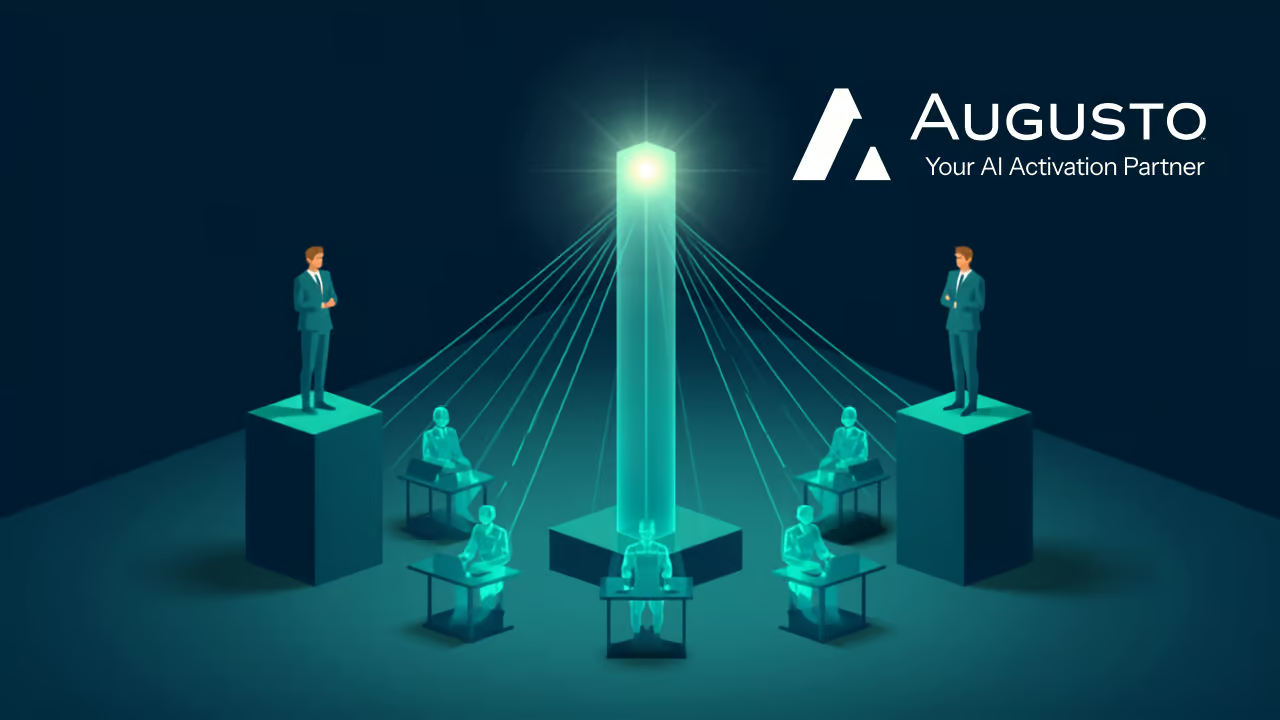
- Someone supervises the fleet: The most developed model in the room was a lead agent that knows the business, with worker agents reporting to it so accountability, permissions, and access stay appropriate. One leader called it a chief of staff for agents: the agents work for individual people, but the chief of staff watches all of them.
- Verification is designed in, not bolted on: The simple rule is that AI output gets verified before it ships. The honest complication raised at the table is that you use AI precisely because it processes more than a person can, so define verification per role: spot checks, thresholds that require human sign-off, and evaluations that watch the agents’ quality over time.
- Guard what the agents learn: Agents absorb how your company works from meetings, documents, and systems. One sharp warning from the session: if the loudest voice keeps saying “this is the way I do it,” the system will decide that is how it is done. Somebody has to curate the context intentionally, or you memorialize the wrong process at machine speed.
The org chart, in practice
Put those principles together and the structure has three layers. At the top, human function owners: the same leaders on your org chart today, now each accountable for the agents in their function. In the middle, an orchestration layer: the chief-of-staff pattern, whether that is a supervising agent, a platform, or a named person, that monitors permissions, performance, and boundaries across the fleet. At the bottom, worker agents with written job descriptions, scoped data access, and a clear human owner.
Notice what this is not. It is not a new AI department owning every agent, which recreates the bottleneck agents were meant to remove, and it is not agents scattered wherever enthusiasm lives. If you are still deciding which work belongs with agents at all, our breakdown of deterministic and non-deterministic agent workflows and our framework on when AI should make the call pair well with this post.
Start with one function, not forty agents
Across our client work, the pattern that succeeds starts narrow. One organization we partner with made coordination the first rule, because they did not want three different people quietly building the same agent. Another is expanding a knowledge tool from a single user to a multi-user, permission-based system, growing the structure with the fleet instead of after it. And in one rollout, accountability moved to managers rather than individuals, and participation in the supporting training jumped significantly. Structure first, scale second.
If your team is earlier in the journey, our primer on what AI agents can do for your business right now is the on-ramp.
The org chart is the activation plan
The gap between AI aspiration and AI that works shows up here as clearly as anywhere. Aspiration is forty agents by spring. AI that works is forty agents that each have a human owner, a job description, a supervisor, and a verification path. That is Company Intelligence in the most literal sense: your company’s structure, extended to its newest workers.
Diagnose one function, give its agents a real place in the organization, and stand behind them in production. Put AI to work for your people, and give it a manager while you are at it.
Frequently Asked Questions
What is an AI agent org structure?
The set of ownership, supervision, and accountability rules that place AI agents inside your organization: which human owns each agent, what each agent is scoped to do, and who monitors the fleet.
Who should be responsible for an AI agent’s output?
The human leader who owns that business function, not IT by default. IT typically owns the platform and permissions; the function owner answers for what the agent produces.
Do AI agents really need job descriptions?
Yes. A short written scope covering purpose, data access, boundaries, and escalation rules is the single most effective guardrail, and it makes supervision possible.
How many agents should we start with?
One function and a handful of agents under one owner. Prove the ownership and verification model there, then scale.
Let's work together.
Partner with Augusto to streamline your digital operations, improve scalability, and enhance user experience. Whether you're facing infrastructure challenges or looking to elevate your digital strategy, our team is ready to help.
Schedule a Consult