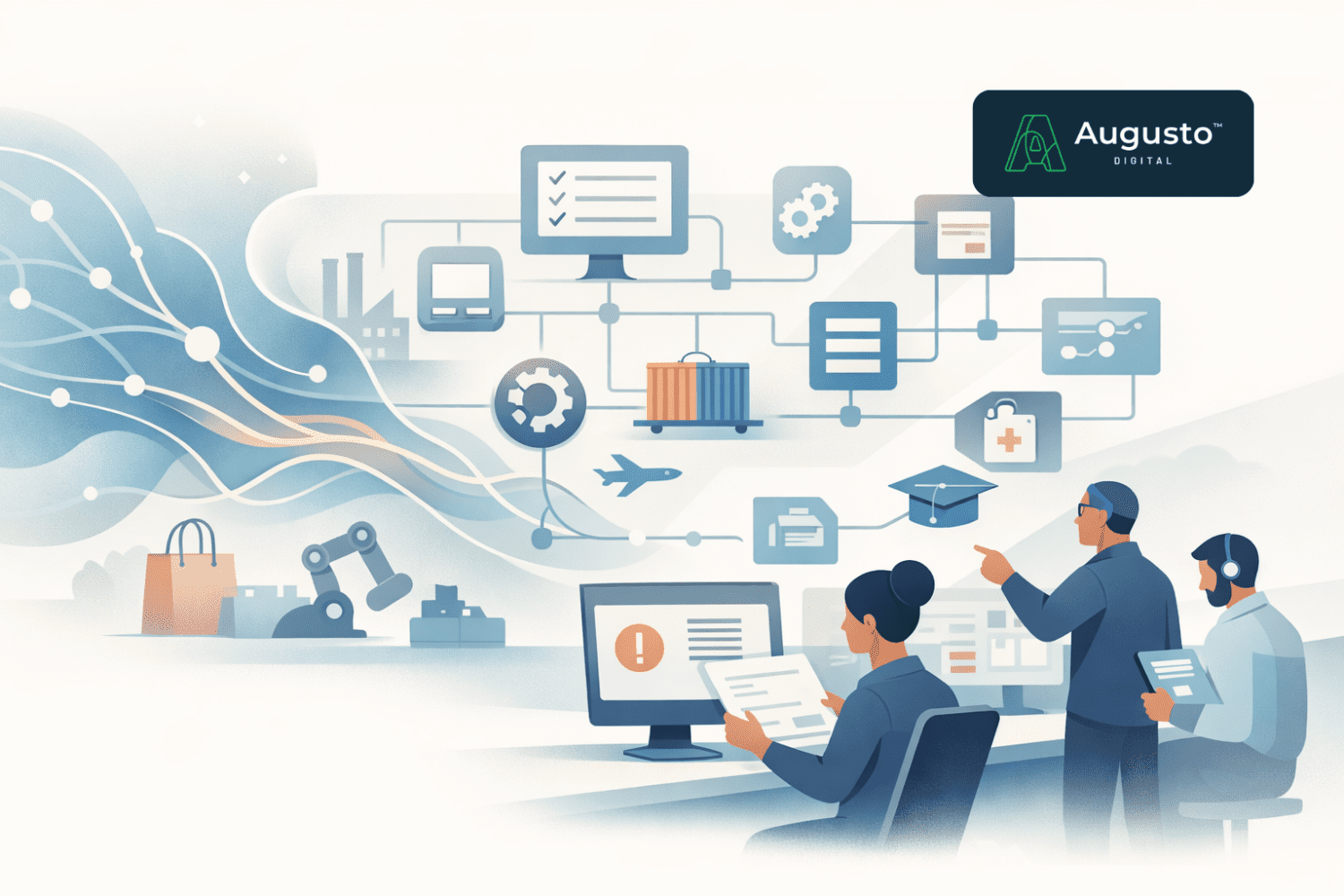
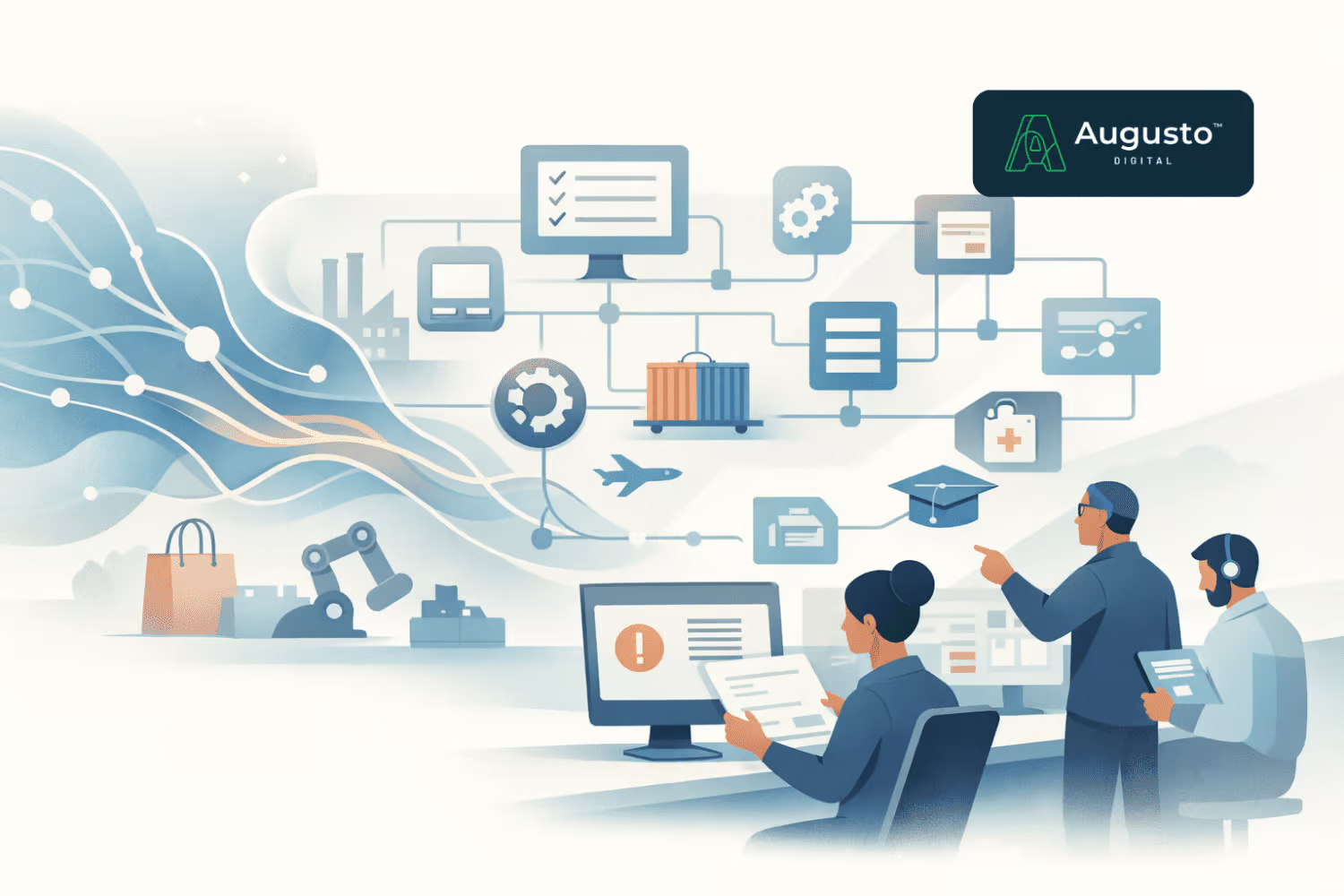
AI trends in 2026 are coming together quickly, but the teams that get the most value won’t be the ones with the most tools. Instead, they’ll be the ones that:
- Choose the right tasks (high-volume, rules + judgment, clear exception paths)
- Use AI to help make choices (classify, extract, summarize, recommend)
- Use automation to do the work (route, update systems, trigger workflows)
- Design for trust from the start (human-in-the-loop, audit trails, guardrails, monitoring)
Adoption is already mainstream. In fact, the performance impact is showing up in day-to-day work: 57% of professionals use AI to explore innovative approaches, 58% of companies plan to increase AI investment, and 88% of professionals say LLMs improve the quality of their work output.
If you’re leading operations, customer experience, finance, HR, sales, or IT, this is a chance to reduce delays, speed up work, and give your teams more time for higher-value work.
Why is AI + automation different in 2026 than past automation waves?
Historically, automation was great at repeatable tasks. However, it struggled the moment inputs became messy, such as emails, PDFs, chats, images, and “almost the same” requests that require context.
Generative AI changes that. As a result, it can interpret unstructured information and produce structured outputs, which means automation can finally scale beyond pristine forms and perfectly standardized processes.
The result is a clear division of labor:
- AI makes sense of the world (language, intent, ambiguity)
- Automation executes reliably across systems (CRM, ERP, ticketing, HRIS, finance tools)
That’s why “AI + automation” is not a trend. Instead, it’s a new operating model.
When done well, it reduces cycle time and rework because teams can finally automate the messy parts of work (emails, PDFs, chats) while keeping humans in control of exceptions.
What are the two proven patterns for combining AI and automation (AI-first vs automation-first)?
In practice, most organizations settle on two patterns. The best teams choose deliberately, one workflow at a time.
- AI-first (interpret → decide → act): Use this when work starts with unstructured inputs like emails, PDFs, chats, images, and free-form requests.
- AI classifies intent and extracts key fields.
- AI drafts a recommended action (include confidence and citations where possible).
- Automation routes the work, updates systems, and triggers next steps.
- Humans review exceptions and low-confidence cases.
- Automation-first (act → enrich → optimize): Use this when work is structured but decisions need better context.
- Automation gathers and prepares the data.
- AI summarizes anomalies, explains drivers, and recommends next actions.
- Automation executes approved actions and documents outcomes.
Augusto POV: Don’t debate “AI vs automation.” Instead, decide where interpretation is required and where execution must be deterministic.
Where does AI + automation create the most value across industries?
Overall, the market signals are consistent. Hyperautomation, AI-augmented RPA, and low-code democratization continue to rise to the top of 2026 priorities. In fact, these are the Top AI + automation trends leaders are tracking
Across sectors, the same leadership titles continue to show up. However, while the workflows differ, the value drivers are consistent: throughput, accuracy, cycle time, and customer experience.
Customer service & support (all industries)
In this function, AI and automation work together to handle both interpretation and execution.
- AI triages tickets, detects sentiment, and suggests responses
- Automation updates systems, triggers refunds/returns, routes escalations
For example, across industries:
- Retail/eCommerce: return request → extract order details → auto-create RMA → notify warehouse
- SaaS: “billing issue” email → classify → update subscription → generate invoice correction
- Travel & hospitality: complaint message → sentiment + category → service recovery workflow
Sales & revenue operations
Similarly, AI supports decision-making while automation ensures follow-through.
- AI drafts proposals, summarizes calls, and identifies next steps
- Automation creates opportunities, schedules follow-ups, and updates CRM
Examples include:
- Professional services: RFP intake → extract requirements → build scope skeleton → route for pricing
- Financial services: lead form → risk/fit classification → schedule KYC prep call → open record
Finance & accounting
In finance, the pattern repeats with a focus on accuracy and speed.
- AI extracts fields from invoices/receipts, flags anomalies, and explains variances
- Automation matches, codes, routes approvals, and updates ERP
For instance:
- Logistics: proof-of-delivery → reconcile invoice → flag exceptions → notify account owner
- Manufacturing: supplier invoices → detect PO mismatch → route to buyer with evidence
HR & people ops
Likewise, AI + automation reduces friction in people-centric workflows.
- AI summarizes candidate screens, classifies HR requests, and drafts policy answers
- Automation creates onboarding tasks, provisions access, and updates HRIS
Examples include:
- Healthcare: credentialing packets → completeness check → route missing items → start onboarding
- Education: hiring paperwork → extract fields → create payroll setup → trigger orientation workflow
Operations & compliance
Finally, AI + automation plays a critical role in risk-heavy environments.
- AI reads policies and evidence, drafts audit narratives, and identifies gaps
- Automation collects artifacts, logs actions, manages approvals, and tracks remediation
For example:
- Fintech: compliance review request → gather evidence → summarize risk → route for sign-off
- Energy/Utilities: maintenance reports → extract findings → create work orders → schedule crews
How can leaders implement AI + automation in 90 days?
If you want results in a quarter, focus on one workflow, then prove value quickly, and finally scale.
- Pick a workflow worth fixing: Target work that is high-volume, slowed by messy inputs, full of handoffs, and easy to measure (time, cost, backlog, error rate).
- Map the process, including exceptions: Document triggers, required fields, decision rules, exception types, and who owns each exception. Most automation fails in the edge cases.
- Set guardrails before you pick a model: Define what can run autonomously, what requires approval, confidence thresholds, escalation routes, and audit requirements.
- Pilot with real users in production-like conditions: Track cycle time reduction, percent handled end-to-end, exception rate, satisfaction, and the top error patterns.
- Instrument, monitor, and improve: Implement monitoring dashboards, QA sampling, an iteration cadence (prompts and workflows), and change control.
Augusto POV: Success isn’t the model. Rather, it’s the operating system around it.
What are the biggest risks with AI + automation, and how do you avoid them?
- Automating a bad process won’t solve the root issue. Instead, fix the flow first then automate.
- No one owns exceptions: Assign exception ownership explicitly. Design the workflow so exceptions surface early and route to the right person.
- Shadow AI spreading across teams: Standardize guardrails, approvals, and tooling so teams can move fast without losing control.
- Poor data quality and disconnected systems: Clarify the system of record. Make sure automation writes back cleanly and consistently.
What will matter most by 2026 as AI and automation converge?
By 2026, the differentiator will be how fast you can turn signals into action.
Organizations that win will:
- Treat AI as a product, not a demo
- Combine AI interpretation with reliable execution
- Create a culture of measurable improvement
How can Augusto help you implement AI + automation?
At Augusto, we help teams move from experimentation to outcomes by:
- identifying the highest-value workflows to modernize
- designing the right AI + automation pattern
- building guardrails, monitoring, and exception handling
- integrating across your existing stack (not replacing it)
In short, if you want to explore one workflow where this could save weeks of time or eliminate recurring friction, then let’s talk.
Let's work together.
Partner with Augusto to streamline your digital operations, improve scalability, and enhance user experience. Whether you're facing infrastructure challenges or looking to elevate your digital strategy, our team is ready to help.
Schedule a Consult