Most AI projects do not stall because the technology is weak. They stall because nobody decided how much freedom the AI should have before it went live. That sounds like an engineering detail, yet it is a business call about risk, and it belongs to leadership.
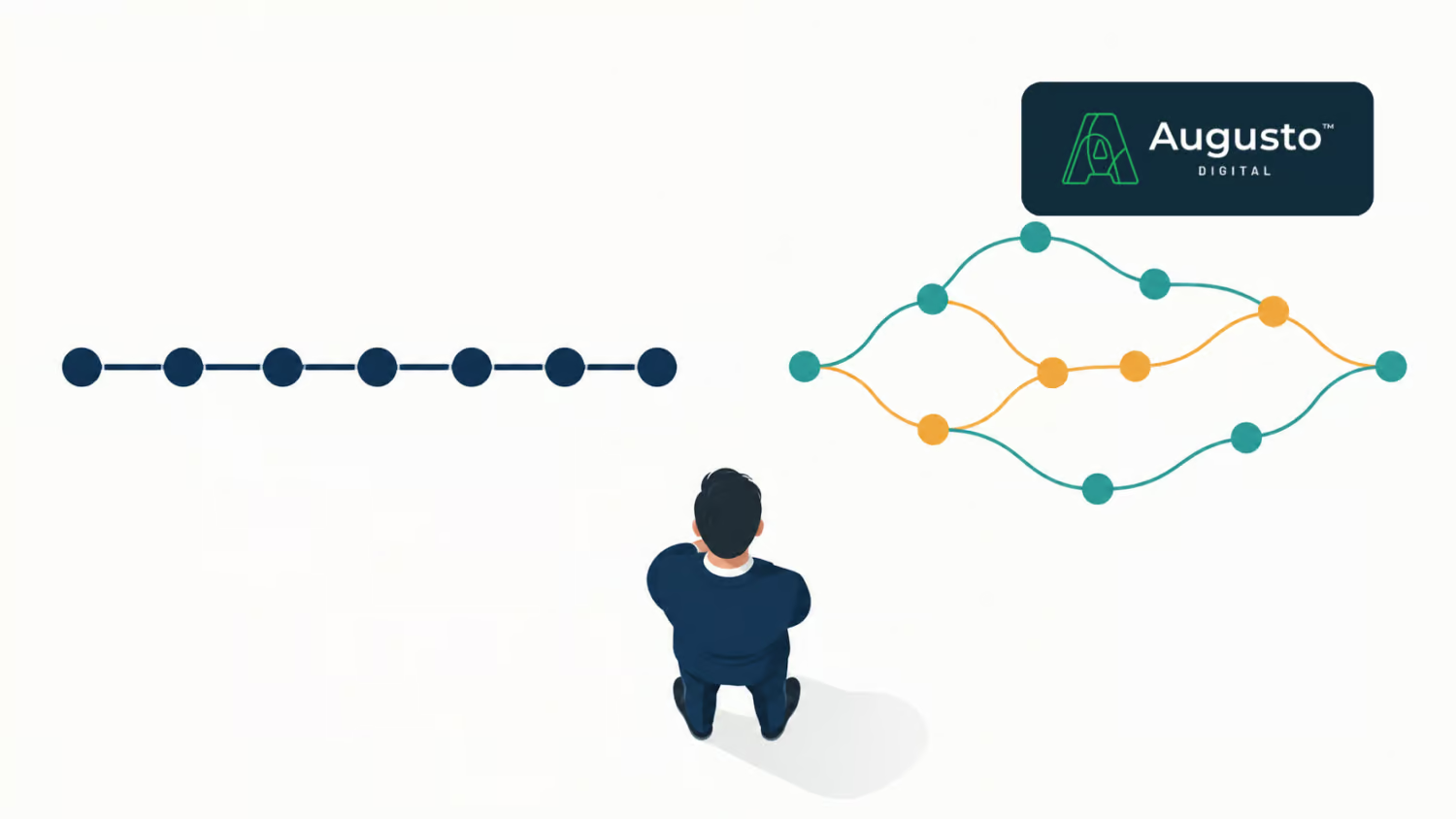
Here is the choice in plain terms. A deterministic workflow follows steps you define, in the same order, every time. A non-deterministic agent picks its own path based on the situation in front of it. Both earn their keep. Confusing them turns a promising pilot into something nobody trusts enough to use.
The difference that actually shows up in your numbers
Deterministic means repeatable. Feed the workflow the same input on Monday and again on Friday, and you get the same result. Because of that consistency, you can test it, audit it, and explain it to a customer or an auditor without hedging. Rules-based pricing, invoice matching, and document routing all belong in this category.
Non-deterministic means adaptive. The agent reads context, weighs options, and chooses what to do next. Naturally, that flexibility is the whole point when the work is messy. One manufacturing leader we work with gets handed 5,000-page compliance manuals to review before quoting. As he put it, an agent reading those pages “may not be perfect, but it’s going to catch the 80%, 90%.” Nobody was reading all 5,000 pages before, so partial coverage beats none.
The question is never which approach is better. It is which one fits the cost of being wrong.

Start with one question: what does a mistake cost?
Before anyone writes a prompt, answer that. A wrong ticket assignment costs a few minutes of rerouting. A wrong number on a customer quote costs margin and credibility. Those two situations deserve very different designs, though teams routinely build them the same way.
We use a simple layered test with clients, and it maps cleanly to how experienced workflow engineers think about the problem:
- Risk of error: If a mistake is cheap and easy to catch, lean toward more automation. If the work touches regulated data or goes straight to a customer, add a human checkpoint early.
- Nature of the task: If the task runs on clear rules and lookup tables, and you can measure the answer against a known correct value, full automation is realistic. If the task depends on judgment or context the model may read wrong, start it as an assistant to a person instead.
- Measurability: If you cannot define what “correct” looks like, you cannot claim ROI later. Define it first.
Most disappointing pilots skip step three. They launch something impressive, then discover months later that nobody can prove it worked. That gap between AI ambition and AI that holds up in production is where most pilots quietly die.
Reliability is something you build, not something you hope for
Here is the part that separates a demo from a system your team will actually rely on. Even when an agent behaves unpredictably by design, the workflow around it does not have to.
On one client quoting workflow, our team built an evaluation trigger directly into the process. The workflow receives expected values, compares its own output against them, and flags anything that drifts. In practice, that means accuracy gets tracked continuously rather than spot-checked by someone with spare time. On another engagement, a second program grades the first one, reviewing whether an information extractor pulled the right fields and then suggesting specific improvements.
Neither addition is glamorous. Both are why the results hold up. The NIST AI Risk Management Framework makes a similar point: measurable, documented controls are what make AI trustworthy over time, not the sophistication of the model.
Move your people from in the loop to on the loop
Early on, a person usually checks every output. That is appropriate, and it is also slow. Over time, the goal shifts. One of our leaders describes it as moving from human in the loop to human on the loop, where the process runs continuously and people review exceptions instead of acting as a cog in the machine.
Notice what that shift does for your team. Your reviewers stop rubber-stamping routine work and start applying judgment where judgment actually matters. Capacity opens up without anyone losing a job. In one finance conversation, a CFO looked at roughly 6,000 annual hours across a three-person accounting team and saw a path to a fraction of that, with the balance redirected toward analysis rather than counting.
One catch is worth naming. Whoever validates the output teaches the system what “right” means. A CEO we work with put it bluntly: much of what a company knows is tribal knowledge, and the honest answer is often “it depends on the customer.” Feed that ambiguity into an agent without a qualified reviewer and you scale the wrong answer efficiently. Choosing your validators therefore matters as much as choosing your tools.

What this looks like when it works
The pattern is consistent across the operations and finance work we run. Lock the steps where rules are clear. Let the agent think where input is messy. Wrap both in evaluation you can show a board. Then put your people on the loop rather than inside it.
Results follow that discipline. On one quoting process, turnaround got fast enough that customers commented unprompted, and roughly 90 percent of the work behind those quotes was automated. Elsewhere, a manual pricing routine consuming three to four hours daily became a background process.
Augusto does not stop at recommending which approach fits. We build these workflows, instrument them, and keep them running as your business changes, because an agent that worked last quarter will drift once your products or pricing move. Deciding where AI goes first is the guidance half. Keeping it dependable in production is the execution half, and you need both.
If your pilot produced a strong demo and an unclear answer about value, that is usually a design question rather than a technology problem, and a short conversation with our team is the fastest way to tell which one you are facing.
Frequently Asked Questions
What is a deterministic AI agent?
It is an automated workflow that follows steps you define, in the same sequence, producing the same output for the same input. Because the behavior repeats, you can test and audit it confidently.
When should we use a non-deterministic agent instead?
Choose adaptive agents when input varies widely and no fixed rule covers it, such as reading long unstructured documents. Accept that output will vary, then design review around that.
Can you make agent workflows auditable?
Yes. Build evaluation into the workflow so it compares output against expected values and flags exceptions automatically. That record is what makes the system defensible later.
How do we know an AI workflow is actually working?
Define what a correct result looks like before launch, then measure against it continuously. Without that baseline, you have activity rather than evidence.
Let's work together.
Partner with Augusto to streamline your digital operations, improve scalability, and enhance user experience. Whether you're facing infrastructure challenges or looking to elevate your digital strategy, our team is ready to help.
Schedule a Consult