That’s $29k per employee. Per year.
In a recent Augusto leadership meeting, the point was made that our client roundtables generate a massive amount of intelligence worth sharing across the company. Nobody in the room treated that as a nice sentiment. We treated it as an operating requirement, because we had already built the system that makes it true: every conversation we have is captured, mined, and turned into knowledge the whole company can use.
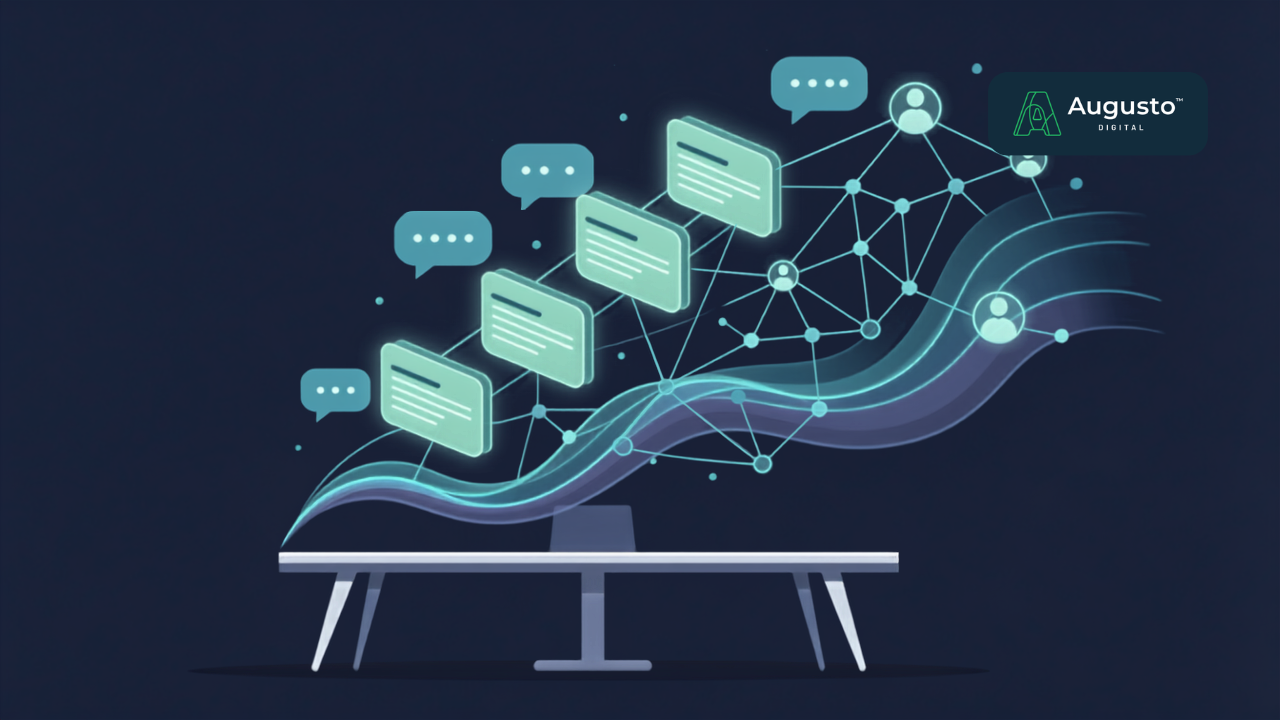
Most companies run the opposite way. Their best thinking happens out loud, in meetings, and then most of it disappears. The decisions, the commitments, the client saying something that belongs in a case study, the early warning sign in a customer’s tone. It all happened, and a week later almost none of it exists anywhere. That gap between what gets said and what gets kept is the whole argument for AI meeting intelligence.

The Evaporation Problem
The research on this is brutal. Without follow-up notes, 70 percent of decisions made in meetings are forgotten within 24 hours, and 47 percent of action items discussed are never captured at all. This is not a discipline problem. People speak faster than anyone can reliably record, and the person taking notes is also trying to participate.
Now put a price on it. The average employee spends 392 hours a year in meetings, at a cost of roughly $29,000 per employee per year, and executives average around 23 hours a week. Estimates of what unproductive meetings cost US companies run from $37 billion to $399 billion annually. Your company is already paying full price for these conversations. The only question is whether you keep what you paid for.
What Meeting Intelligence Actually Means
Most leaders hear this topic and picture an AI note-taker that emails a summary nobody reads. That is the shallow version. AI meeting intelligence means the conversation becomes structured, searchable business data. We know because we built this for ourselves before offering it to clients.
The capture layer comes first, and ours is standardized: every call at Augusto is recorded with Fathom, our company-wide AI note taker. We like it because it does the unglamorous part flawlessly. It joins every meeting automatically, produces an accurate transcript with speaker labels and timestamps, and delivers a summary with action items before anyone has left the call. Just as important for what comes next, every moment carries a deep link, so any quote or decision can be traced back to the exact second it was spoken in the recording.
From there, every call flows into a system we call our Second Brain, and this is where Fathom’s clean transcripts become compounding value. AI reads each Fathom transcript and extracts the action items, with owners. The system identifies ROI signals when clients describe measurable outcomes in their own words, detects relationship signals such as appreciation, concern, or renewal risk, and maps attendees, their connections, and trending topics across every engagement.
Before a client meeting, anyone on our team can pull a prep brief built from the entire history of the relationship. When we write a case study, the client quotes are real and verbatim, because the system kept them. This is the same agent workflow pattern we apply to any document-heavy process, pointed at conversations instead. It even feeds our marketing: the proof points in our content pipeline, described in how Augusto automates content creation, come out of these meetings.
What Changes When Conversations Stop Evaporating
The first shift is follow-through. Teams that adopt AI-generated meeting summaries see action-item completion rates rise from the 50 to 60 percent range to 85 to 95 percent, largely because a searchable record kills the follow-up meetings scheduled to clarify what the last meeting said.
The second shift is institutional memory. When a veteran team member leaves, their client context does not leave with them, because two years of their conversations are searchable. When someone new joins an account, they read the relationship’s history instead of asking five people to repeat it. And leadership stops flying blind between quarterly reviews, because concern and satisfaction signals surface from calls as they happen, not months later in a churned account. None of this requires anyone to change how they run a meeting. The meetings you already hold become an asset instead of an expense, which is the cleanest ROI case we know. Our guide on measuring AI ROI before you invest shows how to baseline it.
How to Start
The pattern is simple. Record by default, with clear consent and sensible exceptions. Pipe transcripts into a system that extracts action items, signals, and people, rather than a folder of files nobody opens. Connect the output to where work actually happens, your CRM, your project tool, your team channels. Keep a human reviewing anything that drives a decision. Start with client-facing calls, where the evaporating value is highest, and expand from there.

Your meetings already contain the intelligence. The only thing missing is the system that keeps it. If you want to see what a Second Brain would look like on your own calls, start a conversation with our team.
Let's work together.
Partner with Augusto to streamline your digital operations, improve scalability, and enhance user experience. Whether you're facing infrastructure challenges or looking to elevate your digital strategy, our team is ready to help.
Schedule a Consult