
Full Transcript
00:01
All right, let’s talk about content creation and how Austo has done it traditionally. Um, and how we’re we’re using AI to make that process go faster. So, the process stays the same whether it’s AI or not, but we are looking for a keyword that we want to rank for that we
00:16
feel like would be a good uh position for us to rank for based off our ICP and our offerings. Uh, we do that research. We go figure out kind of what are the related keywords? Uh, what are other people searching for? What’s the monthly search volume? How much does it cost if
00:30
we wanted to run ads against that keyword? What how difficult would it be to rank for that? And then from there, we kind of would then analyze that information, come up with a couple blog posts, uh, titles and descriptions that we think would be a good idea, maybe
00:45
some outlines for those blog posts, and then we would go actually write that once we decide on which one we want. And that could be a week-long process to get from a keyword, do all the research, and get to the end where we’ve got an article that’s ready to be published.
00:59
And that’s on a, you know, a week long would be pretty pretty short time frame for some of the stuff. So, uh, what we’ve done now with AI is we can accelerate a lot of that process for us. Uh, so we we start with keyword research. So, I’m going to demonstrate
01:13
that or walk through how we used AI workflow automation as our main keyword. We put it in a spreadsheet. There is a a NADN process that runs through and grabs, if I zoom in here a little bit, all of the related keywords, suggestions, keyword ideas. This is all
01:30
going out looking at Google’s um information about what their search engine provides. So, autocomplete, subtopics, search engine results, and in the end, it drops it into a spreadsheet for us. So, AI workflow automation, what are the related keywords? NAD, that’s a
01:47
big topic for workflow automation right now. Um, gives us monthly search volume. Tells us what someone’s intent is when they’re when they’re searching for this term. Are they just trying to find information about NAND? Is it commercial? They want to go buy it. Uh,
02:02
are they looking for information on a couple different things? What the competition is for that search word, what the keyword difficulty is, and then what the cost per click for those keywords are. And so we take all of this information, we get ideas, suggestions
02:17
down to what’s the autocomplete for all of that. We get all of this information and then we need to figure out what articles we should actually write. So we go through we categorize these keywords and kind of figure out like what are the category categories that we want and
02:32
categories could be things like quick wins. These would be like high search, high monthly search volume, low difficulty, authority builders, high monthly search volume, high difficulty. So those are like if you can rank on that, you are an authority in that one
02:47
or emerging topics. So low search volume but things that people are kind of talking about. And then we create title and description for each one of those keywords. Uh we do the same thing. We take all those keywords and we cluster them into clusters. And then we kind of
02:59
build out HubSpot has a hub and spoke model that they talk about for content. This will create and give us like pillars and supporting pages for each one of those. So when that’s done, we don’t want to just automatically we need to have someone who’s actually picking
03:13
these. So we have a human in the loop process where it basically says hey all your content ideas are ready. Uh go click into this document and then prioritize which article you want to write and then click approve. So if we look at this content um ideas
03:28
opportunities uh you can see it created clusters. Here’s the categories. So what are the categories? The main keyword, what are the keyword? What’s what’s the category for each one of these that it’s looking at? So authority builders, quick wins, um we don’t really know what this
03:42
one is. Uh emerging topics, some of those. And then same thing with clusters. It takes clusters these keywords together. So uh NAN related keywords. So here’s all the keywords that are related to that. Um and then for each one of those, it will create
03:58
content opportunities. So based off a keyword what the category is gives us a title. So master automation with NAND transform your workflow efficiency today and then gives us the description for clusters. It does kind of the same thing and you can see NAN related here uh a
04:15
pillar page the ultimate guide to NAD supporting pages how to set it up with Docker how to you know how does it compare to Zapier. Um, so those would be kind if we wanted to build out a pillar and then a bunch of supporting pages, we could do that here. Um, you can select
04:30
one of these articles. So I picked uh for this one uh supporting page, biggest hopes and fears, 10 biggest hopes and fears for business leaders have about the business leaders have about AI. And so once I’ve selected that, you can kind of see here, here’s the keyword, here’s
04:46
the title, and it keeps the description. And then when I click this approve button here, this process here is going to actually go write the article. So, grabs the information, grabs a bunch of information about Austo, uh, writes out the whole blog post for us in our voice
05:05
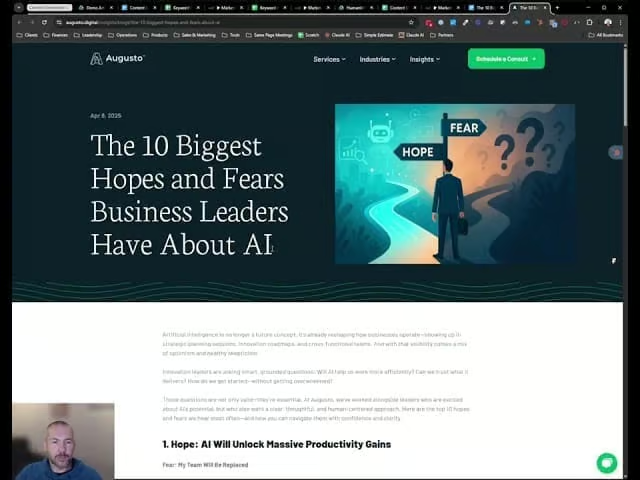
because it’s using our Augusta retrieval augmented generation uh, tool down here, which we’ll dive into in a minute. And then when it’s all done, spits out this article. So, here’s an article that’s written by AI. It has links to other sources. It has links internally um
05:25
where it makes sense. It at the very end creates gives us a metad description for it as well. Gives us image prompt, which if I come back up to the top, that’s where this image came from is that image prompt. And then we can take this information and right now it’s manual uh
05:40
and publish it directly to our blog. And you can see here on our blog where this is this is coming in. Um, taking a little bit deeper. So, so one of the biggest questions when you start getting into content generation is okay, how do I know that this is written in my voice?
05:58
And if we dig into I’m just going to pick one of these uh pieces of it. So, if we’re writing our um blog post, we’re basically doing it in steps, right? So, what are the key takeaways ways we want people to hear from the article? Then we write our introduction and then if I
06:15
come back over here, we’re creating an outline for the rest of it. We’re writing the main body of it. And then we write the conclusion. We assemble the whole article and then we have one final check. But the question that everybody asks is, okay, well, how do I know this is actually in
06:34
Austo’s voice? How does it know about Augusta’s information? And that’s where this rag or Austoto Austoto’s retrieval augmented generation tool comes in place. And you can run these tools and have it ask questions of the the rag. I’m going to refer to as essentially a
06:52
custom GPT uh from now on. So ask that custom GPT questions. And so if I look at the key takeaway agent here and I look at the prompt, I am telling it, hey before writing, use the Austoto rag or the retrieval augmented generation tool to retrieve Austoto specific brand context, IP ICP
07:15
characteristics, industry focus areas, and key value drivers. Your goal is ensure that each takeaway is relevant to Augusta’s ICP. And so if I run this We can test this step. And if I step back, you can see it’s going down here. It’s hitting our rag and it’s retrieving
07:37
information. And then once it’s done, it’ll come back up here. And go back into it. It’s still executing the node here. Spits out this information. And it’s going to write a set of key takeaways. It’ll be a little difficult to read because it’s not formatted very nicely, but here’s some
07:60
of the key takeaways. Cultural shift and strategic impacts, balancing innovation with risk management, um, etc., etc. If I look at the logs here, you can see that it hit Austo’s rag. It said, “Hey, what is Austo’s brand context, ICP characteristics, and industry focus
08:17
areas, and key value drivers?” And then the answer comes out of the rag. So we’ve fed that rag or that custom GPT with information about Austo, who our ICP is, what our values are. So Austo, our brand context centers on being an AIdriven web design and development
08:33
company that creates seamless digital experiences and products to enhance clients interactions with their customers, etc. You know, has a bunch of information that it knows about Austo and it pulls that information out. And then it says, “Hey, what are the
08:47
expectations, pain points, and language relevant to Austoto’s ICP?” So our ICP are centered around their need for value, trust, and digital innovation. Customers seeking to partner with Austo Digital typical typically expect following. So collaboration, outcome focus, growth
09:06
oriented. If I just kind of go through innovation, um what are their pain points? Friction and user experience. It’s basically it’s grabbing all of the information that we’ve told it that we is what our our clients what in our research have looked for. So, uh that’s how we’re getting
09:24
down to a point where our our blog posts have our voice and we could use this for uh many other tools. We happen to be using it right now for content generation. So um in the end this is what we were able to come up with and this whole process uh other than the
09:39
manual pieces we can run this whole process in five to 10 minutes and costs us less than less than 50 cents to generate this blog post.
Let's work together.
Partner with Augusto to streamline your digital operations, improve scalability, and enhance user experience. Whether you're facing infrastructure challenges or looking to elevate your digital strategy, our team is ready to help.
Schedule a Consult