Welcome to the unfiltered founders. I’m Darren. >> I’m Andy. >> Dude, it’s been a chaotic couple of weeks. >> Chaotic. >> We took a couple of weeks off. We’ve been traveling, doing some family stuff, and some vacations. How’s your week back in the saddle been?>> It has been wild in a good way. I got to say, man, there’s there’s all sorts of ways to look at things as an entrepreneur and and I I’m grateful for being one because it’s uh busy and wild in a great way. And uh that’s that’s the way I’m looking at it. What’s a big talk in business now? >> AI, >> right? >> That’s right. And we were just having a conversation before we started the podcast where I’m at a crossroads in my business on how, where, how much, how little to balance AI into my business operations because things are changing, right? > I mean, seriously, three months ago, I would I I looked at AI in my business and I’m like, no, we’re we’re several years out. >> Yeah. Yeah. >> Three months go by, I’m like, we’re there. >> That’s several years in technology time.
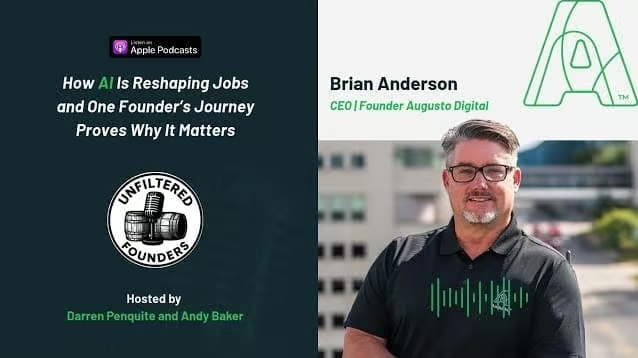
Yeah. just in 3 months. It’s It’s mindblowing at the pace things are moving right now. It’s >> no joke. >> Well, why don’t you introduce our guest today? >> Yeah, we got the perfect guy for that today. Our guest today is Brian Anderson, CEO and founder of Augusto Digital and that’s just austo.digital for the website. And Brian, welcome. We’re glad you’re here and uh tell us a little bit about yourself, where you’re from and and how you came up with the idea for this business. >> Great. Well, hey, thanks for having me on, guys. I’m looking forward to this conversation. Um, you know, I think uh uh a little bit about me. I live in Michigan. Um I’m uh a founder uh and a entrepreneur. I own a few different businesses now. Um Austo being the largest and most successful one that I own. Um I started it. Today is actually our 9-year anniversary. >> Congratulations. some of the some of the hurdles that you hear about with entrepreneurialism, right? Like the first year or the first five years and going to cross the tenure. I’m pretty confident of that. And uh it’s been a great ride, but there’s been a lot of ups and downs on that journey, you know. Um and I was an employee before that for 18 years of my life. I was an employee. And >> what did you do? uh worked well I’ve worked in um I’ve worked in the digital
02:41
space um consulting with clients helping them with uh digital transformation projects product development work and uh I did that working for other great entrepreneurs that I learned a ton from you know two I think two of the entrepreneurs that I worked for won the Ernstston Young entrepreneur of the year and uh had multiple clients win that award too so you know I’ve been blessed to to work with talented people and I finally uh you know pulled the trigger on going full-time as an entrepreneur myself um you know nine years ago now.
>> That’s awesome man. Well congratulations again on that. such a milestone and uh you know tell tell us a little bit about you know the story of you know this went from concept to reality and and kind of talk about the journey from when you had the idea to when you got it up and running. >> Well, how I got Augusta off the ground um comes out of uh uh a lot of reading and uh self-reflection, you know. Um, I I knew early on when I was younger that I was entrepreneurial, but my parents were um they were very focused on, you know, get a great job, go to school, get a great job, you know, save your 40 401k, provide for your family, get a house, you know, all the all the American dream kind of things that they kind of programmed me with. Um, so I really didn’t tap into my true entrepreneurial nature until a little bit later in my life because I went and I lived those things out. I got a great job coming out of school. I worked for an accounting consulting company called Crow and I was on the, you know, system side of that business doing consulting. I I saw a ton. I got to I got to travel a ton and I met with and worked for a lot of different clients of varying sizes um all over the country, traveled globally at times. And so I just had like a lot of exposure through those early consulting years, but I got burned out with the travel because we couldn’t do, you know, video calls with clients. We had to go fly on airplanes. So I was living on airplanes and airports and things and, you know, on at client sites helping them do, you know, software work. And um and so I did that for like
04:59
five years. Then I went and I worked for another um entrepreneur that had built a Microsoft Gold partner and they were you know doing even more engineering work. So I you know I kind of got to learn even deeper engineering and apply the business and consulting skills that I had learned by being at Crow. And I did that for probably seven years, eight years maybe. and they got they got acquired they got acquired by another Microsoft gold partner and then we kind of I went through that merger I saw how that process worked and then they got acquired by another company that was a publicly traded company and at that stage I was it wasn’t right for me and um I was thought about being an entrepreneur at that stage too and I just wasn’t kind of mentally there yet uh I still had a lot of kind of fears and limiting beliefs that were kind of holding me back from making that jump so I took took on um a role for another uh company uh that was a growing technology company um at the time it was called OST and it’s called Vervant now but they um uh I had a really great opportunity to work with another super talented entrepreneur um and he they hired me to build the custom software development pro practice for their company. they had nobody in that practice and um I ended up growing that um with the team there to I don’t know I was like 65 70 people or something when I left and uh and that’s when I started Austo but you know the origin stories that actually finally got me to pull the trigger on going full-time as an entrepreneur was born out of probably frustration and a lot of reading of books >> um I took on a I took on an assignment to um work been growing the Detroit office. So, I live in Grand Rapids and I could drive to Detroit. I’d already done work in the Minneapolis office and stuff, but I didn’t want to be on airplanes anymore. So, I took this assignment to
06:56
drive over to Detroit and work on growing the business for them over there. And uh and I and I did that, but I think in I think my wife had heard too much and so she like said, “You got to start reading books and you got to read this book.” So, she gave me a book on, you know, never work again or something like that as an entrepreneur. And I and I read that book on Audible um on one of my rides over there. And after I read that book, I um I never really listened to the radio again. Like every time I was in the car, I would constantly had an audible audio book playing in my ears, you know. And uh I focused on uh self-improvement, self-awareness, uh entrepreneurialism, investing. Um I got into Robert Kiyosaki pretty deep. I read a lot of his books. Um and uh and many many more. Uh Napoleon Hill, um you
07:48
know, uh Dale Carnegie, uh Stephen CVY, you know, just so many books that basically like reprogrammed my brain, you know, and really helped me like overcome a lot of those limiting beliefs that I had had from my youth. And uh and I and I also had kind of realized through going through that whole journey as an employee and and listening to my parents so much that I did everything they sold me to do, you know. I even accomplished more than what they, you know, they said that like they they always had a dream of having like a cottage on a lake, you know, and I I had a cottage on a lake. I was living up there. I had my boat on a lift in the water. And you know, we were we were living that life for for years when my kids were younger. >> They they dreamed of you buying them a Yeah. Totally. Yeah. Yeah. Um but you know when you do those things as an employee, you know, I wasn’t really I wasn’t really in tune with the fact that like if I really wanted to be wealthy, if I wanted to be free, I needed to have assets and I needed to like think like an entrepreneur. I need to think like um a business owner. And uh you know some of the Robert Kiosaki books when he talks about the cash flow quadrant, you know, I clearly could see at that point I was in the E quadrant. And uh I never meant made it to the S quadrant. I
09:01
switched over to the B quadrant and then I’ve you know focused on B and and and I since then. >> Don’t you love how every job description for a management position in a job posting says we’re looking for somebody who has an entrepreneurial mind. >> It’s like no you’re not. No you’re really not. I promise you >> we don’t last long in corporate America. >> We don’t. >> Yeah. >> No. >> Yeah. I I did get to the point. Yeah. >> Question for you. You’ve been in the technology world for a very very long time. Over the course of those years, decades, what is the single biggest leap impactful leap in technology you’ve seen? >> We’re living in it right now, man. >> We are living it. You know, >> absolutely. I don’t I It’s It’s bigger than the internet. It’s bigger than the iPhone. It’s It is the biggest. I’ll tell you what, in in the late 90s, I worked in I was a radio DJ in the late 90s, and we were still playing vinyl records, CDs, and these old, you know, what they call carts, that big clunky tapes that get thrown into a a deck and they and they reel through, but
10:13
you don’t have to rewind them. They self cue themselves again. It’s continuous reel, similar, >> and that’s what we play commercials and stuff off of. when we started having computers DOSsbased program that could talk to a whole wall of CD players and trigger off music was like okay well now people don’t have to be here anymore we can play music all night long without somebody there playing music and then when hard drives and processors got big enough to start storing the music digitally >> then they’re like oh well we can start recording our voice and inserting it in between songs. It’s called voice tracking. >> And instead of being live on the air for a 4hour show, you could record that 4-hour show in 15 minutes, >> right? >> And all of a sudden, our worlds as radio DJs got rocked. We all went from full-time to part-time. They fired, you know, 75% of the people. >> Wow. >> I was fortunate to keep my job through through all of that. And still today, I still do some radio work. >> Nice. >> Um, >> but you had to get on board with that that technology and I I just don’t I mean AI is kind of doing to the whole world what broadcast automation did to radio and radio in the early 2000s. >> Yeah, I totally agree. >> What are you seeing out there? You, you know, AI, you live it every day. like what’s uh tell us tell us about what you’re experiencing in terms of how businesses are using it, how you’re maybe using it in your business. >> Well, what I see is most people start with chat, right? Like I think the I think the um the evolution of AI starts with you’re you’re most people realize the power of it when they start to work with the chat >> and they realize they’re interacting with these large language models and it’s just unbelievable what can be produced with so little prompting. Right. Yeah.
12:16
>> And you start to you start to like um >> I don’t know your first experience with this pretty much you’re blown away, right? And then you just keep using it and using it and using it. Next thing you know, it’s like part of your daily life. Um, and then and then there’s this evolution. There’s this book called The AIdriven Leader, and I recommend that book. Uh, it’s by a guy named uh Jeff Woods, and he kind of starts talking about how to start using AI as a strategic thought partner. And so, you start going down that path and you start having AI ask you the questions instead of you asking it the questions. and you start to like treat it like it’s a companion that will help you help you think faster and help you think better, right? That’s like another step. Um, and then and then we start applying these things to business. Um, and uh, and in business, you know, most entrepreneurs I know are interested in in in an ROI. They want to they see the potential of AI, but there’s so many ideas, there’s so many shiny objects that they’re not always sure where to start and they they’re a little bit paralyzed, right? And looking for looking for a path, you know? Um or you’ve got someone who’s got like a really crystallized idea. They feel like they know where they need to focus and but they don’t know where to get started. They don’t know how to get it off the ground. And you know, that’s where we our business Austo comes into play. like we we you know we’ve been in business for nine years but what’s happened with AI is really over the last few years. >> Um and so we recognized how powerful it was and I you know through some
13:49
hardships and struggles around what was going on in our business like I made the pivot to say we need to be an AI first company. We need to be an AIdriven company and we need to be a partner to our clients to help them drive, you know, meaningful impact and meaningful ROI in their investments in AI that help them grow and improve their business. And so that is really what we focus on. We sell a partnership. We sell um partnership engagements for our clients. We run workshops. We end up doing pilot projects. And then we do these long-term partnership engagements where we’re just an extension of their team helping them use AI to accelerate and grow their businesses. >> None of us have a crystal ball, but based on your experience because you’re much heav more heavily involved in this and than I am. What do you see, and
14:38
everybody asked this question, I know, but what do you see AI affecting job-wise, employment wise first? Is it accounting? Is it reception? Is it >> what what is it? >> I think it’s I think it I think it starts with um a lot of the entry- levelvel jobs, right? Because the the entry- level jobs are the ones that, you know, people are delegating and elevating and they are, you know, that’s a proving ground for people. That’s a place where you gain experiences and you learn lessons by doing work for other people. Um, and I think a lot of those jobs are being impacted and going to continue to be impacted by AI because the things that they were having these people do are now starting to be, you know, done through, you know, like for example, a research project. I can do a deep research project and get the results back in 15 minutes for something that used to take days to do um, when I was younger. Um, or I can uh, I can automate tasks. So there are significant portions of work that people do that are completely automatable at this stage with with simple workflow platforms that you know use AI agents and where you need intelligence you have it now because intelligence is being commoditized in the form of these AI models. So like people and businesses are starting to figure out like, hey, help me map what some of these jobs are from a process perspective and are they automatable, right? Like do we need someone to do this job that, you know, let’s say they get paid $100,000 a year and $50,000 a year of that money is being spent on this this task that they have to do every single day. And a lot of it is like you start to realize, oh my gosh, I can use AI and I can use workflow automation to automate that work and I can then reposition that person um into something else or maybe we don’t need that job anymore, you know, um or you know, maybe someone’s going to retire and we no longer need to replace that position. So there’s a lot of that work. And then what I see with agents now and the ability for them to be autonomous is they are becoming more and more capable every day to be able to do to be able to reason on their own and
16:55
be able to do the tasks that you know we might have had to build a workflow to automate in the f in the past. You could just kind of direct it um as like a manager of what I want it to do and it will figure out how to do it. So, you know, there are there’s a significant impact to jobs coming and happening as we speak. >> Well, and and I’ll say even on on my perception of AI, it gets kind of scary from the standpoint of just the way our brains work, right? I mean, there’s neuroplasticity. We learn things and they we we continue to form habits and and you know, I always tell my kids, your brain is a muscle, right? It grows with the knowledge that you’re going to put into it and as much as you use it. And with AI, I always go back to think, you know, before Microsoft Word, I was a great speller. Now I don’t spell it as well because it corrects everything. I just, you know, blast stuff out on on, you know, the keyboard and it fixes it, right? >> So, >> what threats do you see with AI and and how careful do we have to be, especially if we use it for our business? I mean, you know, you it’s a large part of your business, but you know, where’s that balance? >> I don’t know if anybody truly knows, you know? I think that I think that if you listen to, you know, the the leaders in this space in the world. Um, I always think of Elon Musk, right? I mean, Elon Musk was talking, you know, two or three years ago about the threats of AI being an existential crisis, an existential threat to humanity, >> you know, and he’s not the only person saying that. Um, if you go on YouTube and you start watching um videos,
18:38
there’ll be plenty of people. There’s um Oh, I can picture his face, but he’s like considered the godfather of AI. Um, Hinton, I think, is his last name. Um, and he was like one of the premier uh, you know, like thought leaders in AI and and built his whole career before anyone even really knew what AI was. And uh, and you know, he’s he’s on a mission right now. He’s video after video talking about how much of a threat AI is to us as humans and and to our world. So I think that it is very real that there’s a massive threat and I and and then you know you watch like uh Ray Kerszswall or read Ray Kurszswall’s books on AI and you know it’s it’s debatable whether humans will be able to ever truly control it you know and if it’s ever stoppable or if it just becomes part of the fabric of our universe and how we actually you know exist in the future. different. >> Here’s a really not dumb question, but and I don’t want the Kla Harris response to it, but what is AI? Is there a one like giant AI like the internet is the internet? Is are there lots of AIs? Is there a central one? How how can you create your own? What what is it? Well, I think most people think of AI in terms of um generative AI, right? Because that’s what they’re experiencing right now. So, and and in generative AI um you know, you have a lot of models
20:17
out there right now that are continuing to grow and become more and more sophisticated kind of independently of each other. You know, you look at Anthropic and Open AAI and Grock and Manis and Deepseek and you know, there’s countries competing right now to like build the best AI models and to like innovate and and uh use AI for, you know, strategic reasons, right? So you know AI I think the general space that we are experiencing primarily is around generative AI and um you know but there’s other forms of AI there’s you know machine learning there’s um you know uh deep learning there’s I mean there’s other types of AI models that exist and uh but I think that it’s I think they’re I think they are if you think of generative AI I like to think of them as like you know they’re They’re brains. They’re they’re kind of a a store of intelligence. And you know, obviously these things are based on neural nets, right? But they are um >> there will be many of them. >> Man creates a baby and the baby matures on its own. >> Great. >> Isn’t that a Isn’t that a creepy analogy? >> That is creepy. Well, so I kind of want to go back for a minute and and dig a little bit more into your story, Brian, about >> real quick before we do that. I got one more. >> Okay, you got Okay, so Darren’s all on AI today. >> At what point does AI come into the
21:47
physical realm where it starts literally building machines on its building physical machines that then physically build things? >> You watched Terminator lately, didn’t you? >> I I did not. No, but I was I was talking to somebody the other day. I I’m like “Oh, yeah. It’ll never take away the bluecollar jobs, you know, the masons, the framers, the roofers, the paver, you know, the people who do construction.” And they’re like, “Oh, yeah. Of course it will.” >> I mean, are are we literally down that that path in our lifetime?
Absolutely. I I think it’s already happening, you know? I mean, you guys have all seen the Boston Dynamics videos, right? Doesn’t that remind you of the Terminator to some degree? You know, when you see these robots being able to do all these things that, you
know, used to be human only things. >> Somebody’s got to build the robots. Or does the AI built? >> The robots are being built. >> Well, well, eventually the AI becomes the brains, right? And and the brain can control the machine and the machine can do what the brain says it should do. Um and uh you know if you just follow Elon Musk right and where they’re going with Tesla I mean they they are significantly focused on a future that where robots are ubiquitous right and u you know this stuff is happening today um you know and
I think it’s going to progress very quickly I think in the next decade um you’ll be surprised at the progress of what happens with robotics and AI. So blueco collar trade jobs are not off the table here. >> I don’t think so. Um and I think I think you know in a lot of things in business it comes down to like a costbenefit analysis. >> Um yeah >> or ethics or morals right and risk. >> So I think I think almost every job is going to be impacted by AI. I think the Walmart CEO, there was just a headline yesterday, I think came out that he was
23:43
basically, it’s in the Wall Street Journal. He was basically saying that, you know, AI is going to impact every job. >> Wow. Yeah, I I saw that article, too. That’s interesting. That was that was a I don’t know. I didn’t look up Walmart stock after that statement, but I can’t imagine it. It went up. Um, so Brian, you started this business from from nothing. I I love that your wife was involved. We’ve had so many conversations with entrepreneurs and and the spouse is is always involved one way or the other and >> bad or ugly. Yeah. Yeah. And so u you know tell us about kind of you had to get to a point where you had to make the leap, right? I mean you had to go from making money in exchange for your time that you were giving to a company to taking a leap and maybe not making anything for a little bit. What was that what was that like? Tell us the story of that part. Oh yeah, that that part of my life is uh is is good but it comes with turbulence you know and struggle because uh I was really struggling being an employee. I had read you know I told you about
24:48
reading all these books. I was working for these other people and I probably read a hundred books during that time because I was driving over to Detroit so many so many times and meeting with all these clients and trying to grow this business for them and uh um you know I would just I got disruptive. I got very disruptive. I was creating problems for you know the managers of that business and and the and I just wasn’t like aligned with their culture and where they were going with things. So I just I was disruptive and so I became um you know not the best employee and uh um they eventually decided to fire me and that was there was like a lot of drama associated with that but you know eventually I got to the point where they fired me and there was this moment where I was like walking out of that office and I was like you know I was emotional about it and uh within like you know a day or two I was like oh my gosh this is the best thing that ever happened to me because I was able to get a severance out of that process. And uh I you know I held a pretty valuable position for them. So they you know and I had a contract in terms of what I was doing with the Detroit work. And so you know I had to hire an attorney but I got a severance and uh that severance basically I used as startup capital and my wife at the time was was staying home as a uh a
26:08
stay-at-home mom. We I mentioned we were living up at the cottage in on a lake in northern Michigan. And I remember telling her, I said, “I think I’m getting fired today, you know, and I’m not going back to get another job after this.” And she’s like, “Okay, I got your back. Do it, you know, whatever you got to do.” >> Awesome. >> And so, you know, but that took like years to get to the point where she would actually say that, you know, >> I love the idea that you get to take your severance that they paid for you and said, “You’re the ones who built your competition.” >> I do. I love that. Isn’t that the greatest? >> Yep. Yep. And uh and then and then you know the funny part about that was I had a little time. So I didn’t I wasn’t desperate to go say, “Oh my gosh, I need to rush in and start this company and start going all in on it.” you know, I spent a couple weeks, you know, I don’t know, wake surfing and fishing and and I eventually invited um two of my long term longtime colleagues, Joel and Jim, who are uh co-founders of Austo, but I invited them up to the cottage before they were co-founders. And I I I took them for a ride on and on my boat and we dropped the anchor in the middle of the lake and I said, “Okay guys, we’re figuring out how to start a business together or you guys are swimming home.” I love >> that was the genesis story of Austo ight there. >> That’s awesome. That’s and that’s entrepreneurship right there. It’s either we’re gonna we’re gonna sink or swim. Absolutely. >> Yeah. >> That’s great. That’s great. So >> would you you know obviously you experienced a ton of emotions from the beginning. Um would you change anything? >> I mean I would have started being entrepreneur a lot earlier. You know I would have um and I was I was bootstrapping stuff. I was building things. I was writing software. I was trying to build SAS businesses at my kitchen table. I had, you know, partnerships with different people. I probably probably started at least a dozen businesses at this stage, you know. Um, so I I had done some of that while I was employed and I was bootstrapping and and you know, that was that was really hard, right? like I I I thought we’d have something, but we never got anything to like a cash flow level where I could like quit my job and go start focusing on that. Even though that was the dream to do that, um >> it wasn’t until I like like like you said, I burnt the boat, you know? I was like, I burnt the boats and I’m like, we’re not leaving. We’re staying here. I’m going to be an entrepreneur and I’m going to figure it out and I’m going to deal with the ups and the downs and I’m going to persevere until I’m successful.
28:34
And that’s really what got me to this nine-year anniversary of Austo. >> How many years did it take you to where you finally felt like 100% confident like I’ve made it? >> I don’t know if I ever feel that way, you know. Um >> that’s a healthy thing. That’s pretty much it, right? Um, I think I go through these uh periods of time where I feel like, oh yeah, we’re in a great spot, you know, but those times don’t last forever, >> you know, the the white water comes. You got to navigate it and uh and and you’ll and you’ll make bad decisions as you go
29:12
through the process of being an entrepreneur, you know, because you don’t know everything and you think you might, you know, or you just or you just don’t realize how risky something is until you actually start doing it and you start living it and you realize, oh, well, that’s not the right path, you know. Um or you’ll or you’ll be like me where you get a shiny object syndrome where you really have a vision around wanting to build something or or make something come to life and you start focusing on that and then I start spreading myself too thin and now I’m not very good at anything, you know. So focus is one of the things that I’ve learned through that journey is like I’m going to really focus until I have figured it out and that it’s really a success and I can really have the people around me that can actually run and operate this thing without me in a sense. Um, and uh, that’s that that’s when I feel like I made it. When when I have the when I’m free, when I’m 100% free from the business and it’s running and it’s got a a great team that completely runs it without me, you know, then I’ll feel maybe secure. What what’s your biggest piece of advice for somebody who’s still working in the corporate world who’s kind of like you are sitting around dabbling on their time off with with business ventures and wondering, “Oh, I just can’t make it.” You know, what’s your advice to somebody who’s thinking about it, who wants to do it, but doesn’t have the courage to? >> Start reading books. You know, I I think too many people are um they are programmed by their parents. They are
living the dogma of other people’s lives. They are um uneducated. Um they they are in a hypnotic rhythm that they’re doing the same stuff every single day and it’s comfortable and it’s like scary not to do that. Um there’s a lot of things that like work against you
making that leap and and then you know you’ll feel these emotions too. You’ll feel fear and anxiety and all these things that are holding you back from you know doing what you know in your heart is the thing you should be doing. And so for me books um you know like I mentioned Robert Kiosaki’s Rich Dad Poor Dad book. I mean that was that was a great book for me to read at the time I read it. I’ve read it again. Or Napoleon Hill, like I think Think and Grow Rich is a masterpiece. I think Outwitting the Devil by Napoleon Hill is a masterpiece. Like really getting straight with your soul and figuring out like what is it that you want to do? And you know, um, you know, a lot of that’s being determined and living the life that you want to live, you know. >> I love that. >> That’s awesome. >> I love that. There’s there’s one there’s one saying I I I talk with my wife all the time about this. There’s a very big difference between smart and educated. >> Amen, brother. Amen. Well, I I will say on on your point too, Brian, I there’s a book that
31:59
I’m reading right now called The Gap in the Gain. It’s by Dr. Benjamin Hardy and Dan Sullivan, and it talks about really how we view things. And one of the things that entrepreneurs struggle with is is what they say is typical typically entrepreneurs make the mistake of after
32:15
reaching a goal, they measure it up against an ideal. And that kind of circles back to the point of the book, The Gap and the Gain. We live in this gap of we didn’t accomplish everything, but sometimes it’s hard for us to look back and say this is what we’ve accomplished.
32:28
>> And so, u you know, I mean, congratulations. Hats off to you. Nine years is awesome. Uh it’s been an honor having you on this show and uh you know, we’re looking forward to to following up with you and hearing where you are when you’re in year 15. So, thanks again, Brian.
32:46
>> Yeah, I appreciate it. Thanks for having me. >> Thanks for joining us. We’ll do it again next week. Take care.