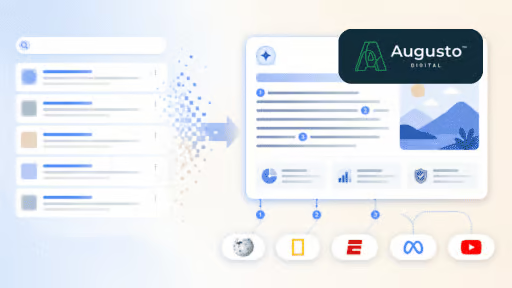
Your B2B buyers are doing something new before they ever click on your website. They are asking ChatGPT, Claude, Perplexity, and Google’s AI features who they should consider, what tools solve their problem, and which vendor stands out in a crowded market. By the time they hit your site, an answer engine has already shaped their shortlist.
This shift is the reason answer engine optimization, or AEO, has moved from a curiosity to a real category of marketing work. Traditional SEO targets blue-link rankings. AEO targets being the answer the engines deliver and the brand they recommend. Both still matter. The companies pulling ahead in 2026 are doing both deliberately.
Why SEO Alone No Longer Cuts It
Search behavior is shifting faster than most marketing teams have adjusted. Recent reporting from Search Engine Land documents that more than half of Google searches now show AI-generated answers above the first organic result, and that click-through rates on traditional links are dropping in those positions. Buyers are also bypassing search entirely and starting their research inside ChatGPT, Perplexity, and Claude, where the answer arrives without a single result page.
The implication is straightforward. Even a perfectly ranked piece of content might not get the click if the answer engine resolves the question first. The work shifts from earning the click to earning the citation, the recommendation, and the brand mention inside the answer itself.
How Answer Engines Pick Their Sources
Answer engines do not rank like search engines. They synthesize. The signals that earn citations and recommendations are different from the signals that earn rankings, even though there is real overlap.
- Authority and consistency: Answer engines weight sources that show up consistently across reputable sites with steady positioning, terminology, and claims.
- Direct-answer structure: Clear claims with specific data points, definitions, and short answers near headers are easier for engines to extract and quote in a response.
- Citation-worthy data: Original research, proprietary benchmarks, and clearly attributed numbers get cited far more than rehashed industry talking points.
- Schema markup: Structured data on your site, especially FAQ, HowTo, and Article schema, helps engines understand what your content actually says.
- Third-party validation: Mentions in trusted publications, podcasts, and analyst reports raise your authority signal in ways your own site cannot do alone.
Five AEO Plays You Can Run This Quarter
If you are starting from scratch, five plays make a measurable difference within a quarter.
- AEO visibility audit: Run buyer-style prompts about your category in ChatGPT, Claude, Perplexity, and Google AI features. Capture which brands are mentioned, which sources are cited, and where you sit. This becomes your baseline.
- Definitive content with structured claims: Pick three questions your buyers actually ask answer engines and publish the cleanest, most citable response in your industry. Lead with the answer, then provide the data, the nuance, and the next step.
- FAQ and direct-answer optimization: Add real FAQ schema to your top product and category pages. Write the answers as short, complete sentences that an engine can lift directly into a response.
- Earn third-party mentions: Pitch a real story to publications and podcasts your buyers trust. One mention in the right outlet often outperforms a quarter of self-published content for answer engine visibility.
- Clean structured data: Implement Article, Organization, Product, and FAQ schema. Use clear, semantic HTML on every page. The technical lift is small and the visibility gain is durable.
Augusto’s growth marketing team runs this kind of AEO program for growth-oriented companies that want to show up in answer engines, not just search rankings. The work pairs cleanly with traditional SEO, and the early metrics are encouraging.
Measuring Visibility Beyond Rankings
AEO needs a different measurement model than SEO. Three signals matter most. First, brand mention rate inside answer engine responses for your priority questions. Second, citation rate of your content as a source. Third, share of voice in answers compared to direct competitors. Tools like Otterly.ai and similar AEO tracking platforms have made this kind of measurement practical, where it used to require manual prompting and screenshots.
The companies winning at AEO are not the ones with the biggest content budgets. They are the ones who measured early, picked specific questions to own, and built a steady cadence of citation-worthy work. The window to lead in your category is open right now, but it will not stay that way.
Frequently Asked Questions
1. What is the difference between AEO and SEO?
SEO targets ranking on traditional search results pages. Answer engine optimization targets being cited, mentioned, or recommended inside AI-generated answers. The disciplines overlap heavily on technical fundamentals like structured content and authority, but they diverge on tactics. SEO chases the click. AEO earns the answer.
2. Will AI answers replace traditional search?
It is unlikely to replace it entirely, but the mix is shifting. Most analysts now expect a hybrid future where AI answers handle a large share of informational queries and traditional search handles transactional and navigational ones. The right strategy is to invest in both, with budget weighted toward the kinds of queries your buyers actually use.
3. How do we know what answer engines are saying about our brand?
Run a recurring set of priority prompts through ChatGPT, Claude, Perplexity, and Google AI features. Capture the responses, who is mentioned, and how your brand is positioned. Do this monthly at minimum, and use a dedicated AEO tracking tool if you want continuous monitoring rather than periodic checks.
4. Do we need to change all our content?
No. Most companies get the biggest gains from updating a small set of high-intent pages: definitions, comparisons, FAQs, and category-level content. Add structured claims, clean schema, and direct answers to those pages first. Save the broader content refresh for the second wave once you see what is working.
5. Which answer engines should we optimize for?
Optimize for the engines your buyers actually use. For most B2B companies, that is ChatGPT, Claude, Perplexity, and Google AI features, with Microsoft Copilot becoming meaningful in some segments. The good news is that the foundational work, like authority, structured content, and clean data, helps across all of them, so you do not need separate strategies per engine.
Let's work together.
Partner with Augusto to streamline your digital operations, improve scalability, and enhance user experience. Whether you're facing infrastructure challenges or looking to elevate your digital strategy, our team is ready to help.
Schedule a Consult