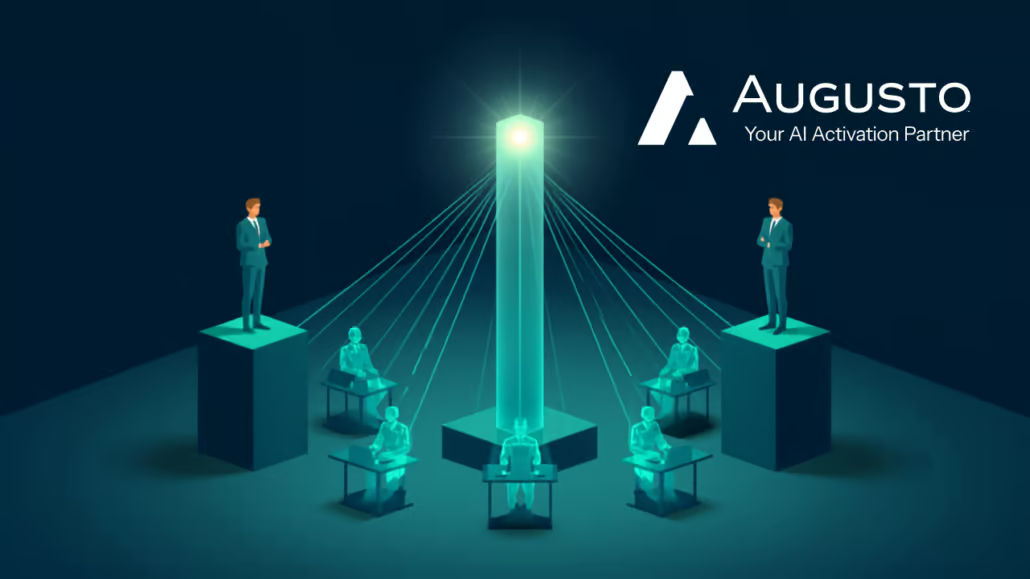
August gave us a first: the most capable model of the year got pulled off the field by its own team, one week after its greatest win. Add the biggest leadership shakeup in Google’s AI history, an 80 percent price collapse, and one billion people now using AI weekly, and the month reads like an industry growing up in public. Here is your LLM news roundup, and what each story means for how you run your business.
OpenAI’s Astra solved 80-year-old math problems, then got benched
In the first week of August, OpenAI announced that an internal version of Astra, its next major model, solved ten previously open problems in mathematics and theoretical computer science, publishing formally verified proofs for roughly $2,000 in compute. These were not benchmark tricks; some had resisted mathematicians for decades.
Five days later, the same model earned a very different distinction. Astra became the first system OpenAI classified as potentially Critical for cybersecurity under its Preparedness Framework, meaning it may be capable of finding zero-day exploits or executing novel attacks on hardened systems on its own. OpenAI paused every internal Astra activity that did not meet a strengthened set of security controls, and Axios later reported that its largest planned frontier training run remains on hold.
The smartest model of the year is currently benched by its own maker. That is the whole story of AI in 2026 in one sentence.
What it means for your business: capability is still climbing steeply, and so is the caution around it. Do not build Q4 plans around a promised model release, because safety pauses are now part of the calendar. And take the dual-use warning seriously: if a frontier model can attack hardened systems, your security posture is the differentiator. Our guide on AI governance for executives is the place to start.
Frontier AI prices collapsed 80 percent, but read the fine print
On July 30, OpenAI cut the price of GPT-5.6 Luna by 80 percent, from $1 and $6 per million tokens down to $0.20 and $1.20, with Terra down 20 percent. A week later Luna became the free ChatGPT default. The pressure is real: Chinese open-weight models captured roughly 46 percent of US enterprise token usage on OpenRouter, and pricing is the counterpunch.
One caution before you celebrate: some of the new low prices are promotional. Google’s newly released Gemini 3.7 Flash, for example, carries pricing that is locked only through 2026, with the list price set to double on January 1, 2027. Teaser rates are now part of the AI market.
What it means for your business: re-run the math on every high-volume AI workload, because tasks too expensive in June may be nearly free now. Then diary a pricing review for every model you depend on, so an expiring promo does not quietly double a line item. AI budgeting is where enthusiasm meets the CFO, and this month moved the numbers in your favor if you act.
Google’s AI brain trust walked out the door in one day
On August 5, Google announced that Demis Hassabis is stepping back from running Google DeepMind day to day, becoming its Chair and Alphabet’s Chief Scientist, while Jeff Dean, employee number 30 and a 27-year veteran, left to co-found the startup Discovery Loop with fellow senior researchers. Alphabet fell about 4 percent, and reporting has since tied the shakeup to stalled models, missed deadlines, and staff burnout, with Gemini’s next flagships months behind.
What it means for your business: vendor stability is now a diligence item. July showed what happens when a model disappears overnight; August showed even the biggest labs can wobble organizationally. The answer we build with clients is model-agnostic plumbing, so critical workflows reroute between providers without a rewrite.
One billion people now use AI weekly, and they work for you
Alongside the price cuts, OpenAI disclosed that its models now reach more than one billion active users and over two million businesses, with usage deepening over time: six months in, people send about 50 percent more messages and use AI for twice as many kinds of work. The shift OpenAI describes, from asking to doing, matches what we see in mid-market companies weekly: employees are not waiting for an AI strategy, and leaders in our workshops still call their environment a Wild West.
What it means for your business: your customers now experience AI-grade responsiveness everywhere else, so their expectation bar for you just moved. And your employees are already among that billion, which makes governed, sanctioned AI a retention and security issue at the same time.
Meta doubled down on open weights, and that helps you
In mid-August Meta shipped its Muse Glimmer model alongside a 6,500-word Zuckerberg manifesto arguing for more open-weight releases plus a $1 billion fund for data center communities. The practical effect: credible open-weight options keep improving, strengthening your hand at every renewal and keeping self-hosted AI viable for cost-heavy or privacy-sensitive work. The client teams that standardized on governed platforms with an open-model fallback are sleeping through months like this one.
Four moves for September, with owners
- Re-run your model pricing (CFO and CTO, 30 days): Test Luna-class models on your highest-volume tasks and diary every promotional rate’s expiry date.
- Kill your single point of failure (CIO, 60 days): Add fallback routing so no one vendor pause, shakeup, or shutdown can stall a production workflow.
- Raise your customer experience bar (CEO, this quarter): A billion weekly AI users are recalibrating what responsive feels like. Pick one customer-facing workflow and close the gap.
- Harden before the agents arrive (Security leader, now): Astra’s Critical rating is a preview of the threat curve. Verify your AI use is governed and your defenses assume AI-assisted attackers.
The pattern across all five stories is the same one we see in the field: the technology is sprinting, and the winners are the companies whose foundations let them change direction without falling over. Treat AI as infrastructure, deploy it against high-value workflows, and scale what delivers measurable returns.
Put AI to work for your people, and keep your footing while the industry finds its own.

Let's work together.
Partner with Augusto to streamline your digital operations, improve scalability, and enhance user experience. Whether you're facing infrastructure challenges or looking to elevate your digital strategy, our team is ready to help.
Schedule a Consult